Accounting, long stereotyped as dull and tedious, has struggled for years to attract young talent. On top of a greying workforce, more than 300,000 accountants left the profession between 2019 and 2022, leaving firms scrambling to fill roles—and, in some cases, contributing to costly reporting errors.
Now, that narrative is starting to flip.
Lower barriers to entry, more conversations about burnout and work-life balance, and the growing use of artificial intelligence to handle repetitive tasks are helping reshape the profession’s image. At the same time, Gen Z workers—more pragmatic about job security and pay—are taking a fresh look.
The result: a quiet resurgence in accounting, with young professionals flowing into a field offering stability, strong demand, and increasingly, lucrative starting salaries.
Take 24-year-old Jack Blazevich. After finishing his degree at the University of Iowa in late 2024, he had a job offer lined up immediately as an assurance associate at PwC in Chicago, making nearly six figures. Though he chose to delay his start until September 2025 to pass all four sections of the CPA exam, it was not out of necessity, but because he could afford to.
“I have not talked to another accounting person who has a degree in accounting who cannot find a job,” Blazevich told Fortune.
Austin Price, working in technology risk assurance at EY, graduated from Brigham Young University last spring and had a similar experience.
“For many of my classmates, it felt like we were recruiting firms just as much as they were recruiting us,” Price said. “We had the luxury of choosing from multiple offers rather than worrying about whether we’d land a job at all. This allowed us to be deliberate about finding the right fit.”
Their experiences stand in stark contrast to the broader job market, where many recent graduates are sending out dozens—sometimes hundreds—of applications. Accounting majors, by comparison, are fielding steady demand, with entry-level salaries hovering around $80,000.
Accounting is delivering near perfect-outcomes at many universities
The appeal of accounting has been more than stability for Blazevich—it’s about optionality.
“When you major in accounting, and you study accounting, you are learning the language of business,” he said.
“I have that flexibility. Accounting people can go to HR, sales, marketing… but finance and HR people, they cannot go into accounting.”
University outcomes reflect that advantage. At Blazevich’s alma mater—the University of Iowa—95% of the class of 2025’s accounting graduates secured a job or continued their education, with median salaries of $75,000.
Similarly, at the University of Texas—ranked No. 1 in accounting by U.S. News & World Report—96.5% of master’s in professional accounting graduates report accepting a job within six months of earning their diploma, with median salaries of $80,000. At the University of Illinois’ Gies College of Business, ranked No. 3, 97% of accounting students in the class of 2025 achieved what the school calls “successful outcomes”—meaning a job or further education—with a median salary of $82,000.
Kristina Right, a senior career services director at Gies, said that in the wake of shifting trade winds, accounting firms have become more targeted in their recruiting strategies, and thus many students are finding success with the networks they build through internships, for example.
“Accounting is probably one of the industries where we still see really strong employment, and our students are probably less impacted by the current market,” she told Fortune.
As a whole, the profession’s pipeline is showing signs of recovery. About 55,000 students graduated with a bachelor’s or master’s degree in accounting in the 2023–2024 academic year, a decline of 6.6% compared to the prior year, according to the American Institute of CPAs. But that drop is notably smaller than the 9.6% decline in 2022–23 and the 7.4% slide in 2021–22, suggesting the freefall may be leveling off.
Broader enrollment data points even more clearly toward a rebound. Total postsecondary accounting enrollment hit 313,397 students in 2025, up from 293,759 the year before, according to the National Student Clearinghouse Research Center.
Many entry-level accounting roles require only a bachelor’s degree, though candidates looking to sit for the CPA exam typically need 150 credit hours, which many fulfill through a master’s or a combined five-year program.
AI may be reshaping the job market—but for accountants, it’s making the job easier
Artificial intelligence—often framed as a threat to white-collar work—is quietly reshaping accounting in ways that may actually make it more attractive.
Rather than replacing jobs, AI is increasingly handling the most tedious parts of the job: data entry, transaction reconciliation, and organizing financial records. That shift is freeing early-career professionals to spend more time on analysis and client-facing work. A report from Stanford’s Graduate School of Business found that accountants who use AI support more clients per week and close monthly books 7.5 days faster than those using traditional methods, while spending 8.5% less time on back-office processing.
At just 26, she’s earning $113,000 as a CPA at a boutique tax firm—a career she arrived at circuitously. After graduating with a finance degree from Arizona State University in 2021, she accepted a role as an accounting specialist at an insurance company and “fell in love” with the work. She went back to school for a master’s in accounting and hasn’t looked back.
While the busy tax season has brought long hours—around 50 a week—Mavashev sees it as a sign of the profession’s health, not a drawback: “It’s very, very rewarding. It feels like you’re playing your part in making the economy better,” she told Fortune.
Blazevich, for his part, isn’t losing sleep over AI rendering his skills obsolete. If anything, he sees the versatility of accounting as a built-in safety net.
That confidence isn’t entirely misplaced. A recent Anthropic study found AI could theoretically handle over 90% of tasks in math and business roles—putting accounting, which sits at the intersection of both, squarely in its sights. But in practice, adoption has been slower. Researchers point to legal constraints, technical hurdles, and the continued need for human oversight.
In accounting, especially, that human layer is hard to remove. A CPA’s signature carries legal weight, client relationships are built over years, and even small errors can trigger regulatory scrutiny.
“At the end of the day, there is going to need to be some human being signing off, or at least reviewing what the AI did,” Blazevich said. “If the accounting labor market shrinks, there’s still going to be a [broader] labor market.”
When Natalie Marshall, better known as Corporate Natalie, landed her first brand deal (a sponsored post for Twisted Tea), she made $500 and felt invincible.
“I was like, I am the richest woman in the world,” she told Fortune. The then-nascent content creator took her friends out to the nicest sushi restaurant she could find in San Francisco (but was really a “hole in the wall place,” she said) and bought everyone dinner.
Marshall, a Notre Dame alum and former Deloitte consultant, started Corporate Natalie as a side project. Over the past six years, she’s developed a character built around the absurdities of office life, from passive-aggressive Slack messages to buzzword-heavy all-hands meetings. The skits resonated. She now has 1.4 million followers on Instagram, 827,000 on TikTok, and 276,000 on LinkedIn—numbers that have attracted brand partners ranging from major tech firms to consumer goods companies.
Pretty soon after Marshall started making content, she realized she could make real money from content creation. To build rapport and the illusion that she was already a well-established creator, she created a fake assistant.
“I made an assistant who was actually just me, operating on my other email alias, looping in my assistant to handle this brand deal,” Marshall said. “So it seemed like I had this whole business and this world around me.”
She may have been orchestrating somewhat of an illusion then, but it worked. Now, Marshall has an entire brand and character in which she parodies office culture across TikTok, Instagram, and LinkedIn, and has three full-time employees working for her. She was also recognized as a 2023 LinkedIn Top Voice and appeared on the Forbes 30 Under 30 list and appeared in a Dunkin’ Donuts commercial with Will Arnett and on a Rokuseries in a Kris Jenner wig playing Charlie Puth’s “momager.” Marshall, 29, also previously produced a podcast, Demoted, with fellow B2B creator Ross Pomerantz, known as Corporate Bro. She declined to share revenue or income with Fortune, and influencer income can vary greatly between follower count, content type, and platform—but some content creators have been known to bring in millions of dollars per year.
Corporate Natalie has gained such a following and been such a success that she’s launching Expand Co-Lab, a creator-led influencer marketing agency, which she believes can overhaul a system she says is fundamentally broken.
“Brands pay massive amounts of money for one singular video to creators, and they often never meet them or talk to them,” Marshall said. “Agencies play this intermediary role that creates separation between the creator and the brand. I sat with that with my team, and we decided we wanted to launch [a] creator led influencer marketing agency.”
The influencer marketing industry
The timing of Marshall’s Expand Co-Lab comes at an inflection point for the global influencer marketing industry, which is estimated to reach $32.55 billion in 2025, up 35% from 2024, according to Influencer Marketing Hub.
Brands are increasingly pouring those dollars into B2B channels. According to TopRank Marketing’s 2025 B2B Influencer Marketing Report, 99% of B2B marketers using an always-on influencer strategy rate their programs as effective, and 72% of the most advanced teams have a dedicated influencer budget they expect to grow.
But for Marshall, more money doesn’t always equate to better outcomes. She argues it’s actually made influencer marketing less efficient.
When you’re a creator, Marshall explained, a brand or agency will reach out to you and offer a certain amount of money to talk about certain topics on their channel, and they’re given a creative brief. But “oftentimes these briefs are written by copywriters, not creators,” which means there can sometimes be several calls to action, many text overlays, and requests for making brand points that have all been approved by their legal teams, she said. She’s rewritten scripts up to 10 times to satisfy briefs that were never built for the type of content she makes.
“We understand that there’s things you have to do to get your message across, but it’s often really difficult, because me, as a comedy creator… how am I supposed to make a joke but also mention all of these things?” Marshall said. “I think the sweet spot that really makes incredible content is when I meet with the brand directly, and we talk through [the] main problem point [they’re] trying to solve.”
Corporate Natalie’s solution to influencer marketing friction
Expand Co-Lab’s premise is simple: Bring creators into the room earlier.
Rather than handing off a 60-slide deck, the agency facilitates direct conversations between brands and creators during the briefing process. This helps everyone focus on what Marshall calls the “one hero moment or message” a brand actually needs. Plus, many content creators almost never get feedback on their work from the brands they work with.
“I don’t know how the campaign performed. I don’t know if I’ll ever speak to them again. Were they happy? Were they sad? I don’t know,” Marshall said. “There’s no communication.”
Expand Co-Lab doesn’t represent talent or take commissions from creators. Instead, it works with a collective of creators interested in the consulting and ideation aspects of the process. Some of the creators Expand Co-Lab works with include Brandon Smithwrick, Varun Rana, Sara Uy, Corporate Bro, Rachel Tokar, Matthew Kearney, and Morgan Young. Marshall said she’s meeting with dozens of new creators weekly to build out the collective. The B2B space is where Marshall sees the biggest white space and where she’s staking her claim.
Marshall has spent six years operating at the intersection of creator culture and the professional world, so she knows both how brands think and how creators work. But even as Marshall continues to expand her business ventures, she’s careful not to make it seem as if everyone can or should be a content creator, no matter how fun or fulfilling the job may be.
“I don’t think everyone needs to be a content creator. If you love filming yourself and you love filming videos, absolutely—stick with it,” she said. “Find the thing that makes you uniquely you… that single point of failure. If you left the company because you’re so good at this one thing, the company would fall apart in some small way.”
Sebastian Leon Martinez had pounded the pavement for New York City mayoral candidate Zohran Mamdani from frigid 23-degree cold snaps in January to the 100-degree day in June when the young democratic socialist stunned the political establishment by winning the primary for the Democratic nomination.
That night, Martinez, a 20-year-old NYU student, found himself “sweaty, laughing, incredibly tired” at Mamdani’s victory party in Queens. It was a “monumental” moment, Martinez told me a week later. “A lot of people around me were crying and laughing,” he recalled. “Talking about how we’ve changed the political system, not only in New York City, but probably for the entire Democratic Party in the country.”
But as the 33-year-old candidate’s supporters cheered Mamdani’s win, business titans from Wall Street to Silicon Valley slid into panic mode at the thought of a socialist running New York City. Hedge fund billionaire Daniel Loeb warned of a “hot commie summer” in a post on X. Fellow billionaire hedge fund manager Bill Ackman pledged to bankroll any New York City mayoral candidate capable of defeating Mamdani.
Is Gen Z rejecting capitalism outright, some wondered, as their millennial counterparts tried to do with the Occupy Wall Street movement in 2011? Could Mamdani’s win spark a full embrace of socialism by the next generation, fulfilling dire predictions about the imminent demise of “late capitalism”?
In a word: no. That’s what I heard in a series of conversations with members of Gen Z and those who study them in the business and political spheres. Most scoffed at the notion that young people are rejecting capitalism on a large scale, or planning any kind of a revolution.
“We’re not seeing young people go live on communes,” said Shana Gadarian, a professor of political science at Syracuse University. “They’re working at banks, they’re starting gig economies, they’re working in high tech. If that’s not capitalism, I’m not clear what would be.”
If there’s a message for political and business leaders to glean from the youth movement buoying Mamdani, it’s perhaps a simpler one: Stop bullshitting us.
“What Gen Z is asking for is honesty,” explained Ziad Ahmed, the 26-year-old head of United Talent Agency’s Gen Z–focused marketing advisory practice, Next Gen. “If the world is on fire, tell me the world is on fire. Don’t tell me that actually, you might like the heat.”
I heard over and over that young people are deeply “discontented” or “disillusioned” with the status quo. Saad Amer, a New York–based climate activist and founder of the sustainability consultancy Justice Environment, said the next generation has been told a “fable” of how to succeed in America.
“What Gen Z is asking for is honesty. If the world is on fire, tell me the world is on fire. Don’t tell me that actually, you might like the heat.”
Ziad Ahmed, Head of Next Gen at United Talent Agency
“Young people are sold the story of, ‘Go to school, get good grades, go to college, and then you’ll get a great job, and you’ll own a home, and you’ll have a family,’” Amer said. “I look around at my peers, and that’s not true for any single one of them.” Instead, he said, he sees people “stuck in careers that they find unfulfilling—and that are also having disastrous impacts on their mental health and the planet at large. It’s clear that what we’re being told isn’t true.”
It’s not just liberal Gen Zers who feel this way. Rachel Janfaza, the 27-year-old founder of youth political culture newsletter The Up and Up, regularly holds listening sessions with young voters across the country. She has seen similar frustrations on the Republican side of the aisle, she said.
“I’ve certainly heard young people on the right who are very anti-billionaire and antiestablishment talk in the same way that we hear young people on the left,” she said. “This type of rhetoric exists on both sides. And I think there are a lot of similarities in why Trump resonates with young people and why perhaps Mamdani resonated with young people.”
Janfaza boils it down to one key issue: economic anxiety. And it’s not just in their heads. The average age of first-time U.S. homebuyers hit a record high last year at 38. In the country’s 30 largest metros, more than half of Gen Z renters are rent-burdened, spending more than 30% of their income on rent, Zillow found. And nearly a quarter of millennials and Gen Zers without children do not plan to become parents, primarily owing to financial stress, according to a recent report from MassMutual.
It’s no wonder, then, that instead of career politicians, Gen Zers are embracing outsider candidates who speak bluntly to this economic anxiety—a strength of Mamdani’s, and arguably Trump’s too. They’re done with dated rhetoric, PR talking points, and leaders “siloing themselves in boardrooms” instead of meeting Gen Zers where they are, Ahmed told me.
Business leaders, take note. Members of Gen Z aren’t just craving real talk—and action—from politicians; they’re also demanding it of their CEOs. Younger workers want the same things previous generations wanted: fair pay, rewarding work, mentorship, job security, a clear and fair path to advancement—and they’re not going to be content with kombucha-filled fridges or other office perks. This is a generation that has grown up with school shootings so frequent they’ve become normalized, with massive student debt, and in the shadow of a looming climate crisis. Of course they are demanding change—both from their politicians and their employers.
Charlene Li, an author who advises companies on digital transformation, told me that the two key value for Gen Z workers are honesty and fairness. Both require transparency: Leaders need to clearly state how success is measured and offer concrete opportunities and financial rewards to employees who meet these measures, she says.
Bleak outlook
Gen Z can’t take for granted the life milestones older generations expected to hit.
38
The record-high average age of first-time U.S. homebuyers in 2024
23%
Percentage of childless Millennials and Gen Zers who don’t plan to become parents, primarily for financial reasons Sources: National Association of Realtors; MassMutual
The word “purpose” is frequently used by consultancies and business advisors to describe what Gen Z truly wants in a workplace. But what does that look like in practice? At the Fortune Workplace Innovation Summit in May, Ahmed told me that workers should understand the “why” behind every business decision. Managers must clearly articulate their reasoning—to both their workers and customers, he said. “I don’t think it has to be as lofty as changing the world, because Gen Z also has a huge bullshit filter, and doesn’t want you to say that you stand for everything if you don’t,” Ahmed said. “Authenticity is everything.”
A good starting point would be a more straightforward discussion of diversity and equity, Li says. Instead of relying upon box-checking or acronyms such as DEI, she advises business leaders to take a hard look at the demographics of who is getting promotions and raises, and to think critically about company—and C-suite—makeup: “That’s what people are looking for, not just Gen Z,” she said. “We’re looking for some authenticity between what you have on your walls and on your websites and how you actually show up.”
Business leaders also need to listen to younger workers—their complaints, thoughts, and opinions about the business and the world. That doesn’t mean you need to hold a town hall tomorrow on the merits of Marxism, but it does require a certain level of respect and thoughtfulness, even for views that leaders disagree with.
“For Gen Z, politics are very personal,” Li said. “Work is going to be deeply personal to them. This is not something where they want to go in and just check off the list. So will you be ready to take that energy and bottle it and direct it?”
Mamdani’s win seems to have brought to the surface generational tensions and anxieties that had been simmering long before he became a political celebrity.
Elizabeth Spiers, a progressive digital strategist and journalist, said political and business leaders tend to conflate younger generations’ criticism of economic systems with political extremism. “They sort of treat capitalism like it’s a sacred cow that can never be spoken of in anything less than glowing terms,” Spiers said. But the precarities that young people face are real, she said: “They’ve grown up in an economic environment where a lot of those myths have sort of fallen apart in front of them.”
Addressing the disillusionment of young people who see corporate hierarchies as fundamentally unfair will take more than just better workplace communication; young people are also demanding real action to improve their economic prospects, both from politicians and from the business world.
Amer, who advises Fortune 500 C-suite executives on climate impact, said he has been “seeing the fear” in business leaders’ eyes when talking about how to work with and engage a young workforce.
“These corporations do have a role that they should be playing, and I think they are actively trying to figure out the role,” he said. “But to the younger generation, the role seems obvious: Do better.”
This articleappears in the August/September 2025 issue of Fortune with the headline “Gen Z’s wake-up call to corporate America.”
Sam Walton’s favorite ice cream, butter pecan, is always available at the Spark Café, in the quaint town square of Bentonville, Ark. Next door is Walton’s 5&10, the five-and-dime store where in 1950, “Mr. Sam,” as he was known locally, planted the seeds of Walmart, a retail empire that became the biggest company in America. That little shop is now a museum, and parked outside is a replica of Mr. Sam’s red 1979 Ford F150, the pickup truck he used to tool around town in, often with his dog Ol’ Roy.
Venture out beyond the square, and the small-town USA illusion breaks. The population of the town surrounding Walmart’s sleek new multibillion-dollar headquarters has soared from about 6,000 in the 1970s to more than 60,000 today, and it’s expected to triple in coming decades as the company attracts top tech and management talent from coastal cities.
The feeling is more glossy high-design hub than Norman Rockwell painting. There’s a Soho House-like private social club and spa, boutique hotels, chef-driven restaurants, speakeasies. At the private-jet-filled municipal airport, you can drink a cappuccino and watch vintage planes take off. There are sprawling parks and playgrounds, paved walking paths, and hundreds of miles of mountain biking trails. The expanding 200,000-square-foot Crystal Bridges Museum of American Art sits on a landscaped 134-acre campus and is free to the public, as is the music and arts center The Momentary.
Much of Bentonville’s transformation has been bankrolled, directed, and shaped by the Walton family, whose approximately 44% stake in Walmart makes them one of the richest families on earth. Walmart is now worth around $1 trillion. Through their various hospitality and investment groups, and their philanthropies, Sam Walton’s children and grandchildren have helped remake the town as a kind of urban utopia in the Ozarks.
On the grounds of the Crystal Bridges Museum of American Art.
Christina Horsten—picture alliance/Getty Images
“They are like royalty in Bentonville,” said Charu Thomas, who chairs the board of Bentonville-based supply-chain tech company Ox and lived there for several years. “It’s a little bit bizarre.”
Lately, however, something has changed. As the Waltons have become more and more involved in the city’s development, some have started to express harsh skepticism about their intentions. In a region where the family seems to have a part in every aspect of life, the closing of a restaurant they own or even a generous loan to the city can cause backlash.
Simmering resentments came to a head in 2023 in the tiny nearby town of Jasper when it was revealed that two Walton grandchildren were exploring whether there would be support to pursue national park and preserve status for one of Arkansas’s most important natural icons, the Buffalo National River. Locals, fired up by rumors that such a redesignation could lead to unwelcome tourism, development, or even them being pushed off their land, packed a town hall meeting. They erupted in applause at an anti-elite country song one indignant resident had reworked: “Rich Men Not From Here.” It was very clear who the “rich men” were. A Republican state senator who spoke against the redesignation campaigned this year with flyers boasting: “Bryan King said no to the billionaires,” and won reelection in March.
Stunned by the firestorm they set off, the Waltons dropped the effort to redesignate the river. But the outcry marked a tidal shift in sentiment and exposed long-festering resentments. It underscores a split that has existed in America as long as the nation has, between rural and urban, rich and poor. That divide has grown especially raw lately, as the wealth gap widens and a populist backlash against billionaires has gathered force.
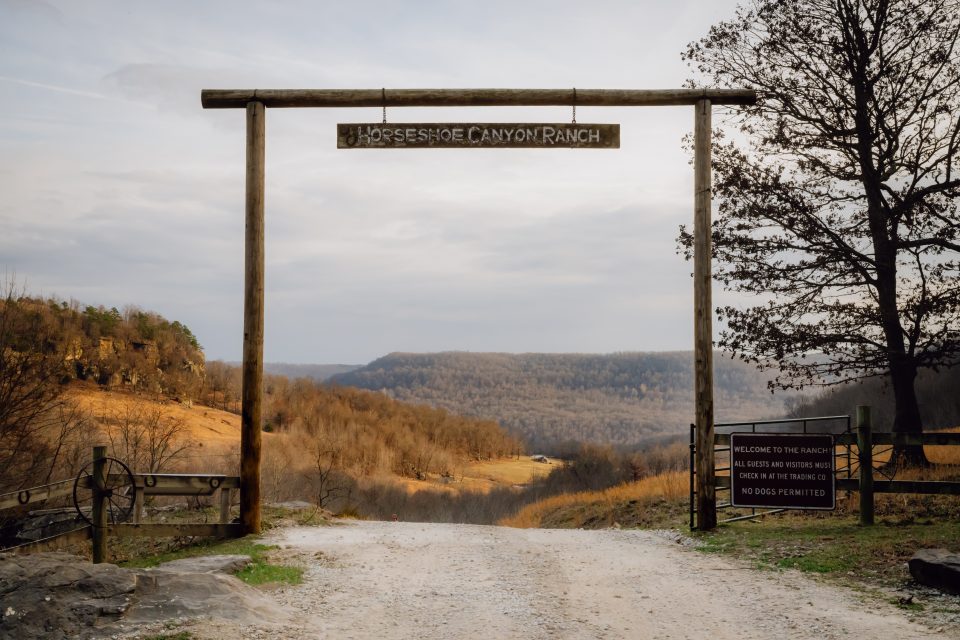
Residents around Jasper, where the Waltons own Horseshoe Canyon Ranch, were upset that two Walton grandchildren had funded a survey about redesignating the Buffalo National River.
Desiree Rios for Fortune
As the ultrawealthy fund political campaigns and amass influence, the billionaire class has been under fire. In California, progressives and unions are pushing for a “wealth tax.” In New York, efforts by billionaires to defeat a democratic socialist mayoral candidate backfired spectacularly.
In Bentonville, there are no protesters marching with signs. But growing pushback against the Waltons is showing up in snarky Instagram posts and damning opinion pieces in magazines. It goes to the heart of a community that has for decades revered and identified with Sam Walton and his kin—and to some of the inherent tensions in large-scale civic philanthropy.
Few families in American history have given, invested, and loaned so much capital to a small community. And the community certainly values them: Indeed, a former governor told me he worked to reduce Arkansas’s tax rates specifically to entice some of the Waltons to move back.
$440 billion
Approximate value of the Walton family’s ownership stake in Walmart, which has a market value of about $1 trillion. The Waltons own about 44% of the Fortune 500–topping big-box retailer and e-commerce giant.
In Bentonville, the Waltons’ enormous power and influence is emerging as a kind of double-edged sword: With one check, the Waltons can—and have—transformed lives. With a change of heart or strategy, however, they can—and have—crushed dreams.
To report this story, I spoke with more than two dozen people, attended city meetings, and reviewed hundreds of email exchanges, grant agreements, and nonprofit disclosures, some obtained via Freedom of Information Act requests. While the family largely avoids the spotlight, Sam’s daughter, Alice Walton, and two of his son Jim’s children, Tom and Steuart Walton, remain active and public-facing in Arkansas. Tom and Steuart sat down with me to share their perspective. Alice Walton declined to comment.
I should note: I live here, too. I moved to Bentonville from New York in 2020, and quickly fell in love with the small-town charm; the kindness of the people; cycling on gravel roads and getting chased by local farm dogs. And much of what I like about my adopted hometown I can thank the Waltons for: I can go see Wicked at the Walton Arts Center, then listen to folk music in a dive bar. I can ride my e-bike, subsidized by a Walton-funded city grant, around town, or drive 45 minutes to hike in the wilderness.
It’s evident that, despite their generosity, at least some of the goodwill the Waltons have generated over decades has begun to erode. Some accuse the family of gentrifying the town, or treating it like a kind of feudal society. Others were reluctant to talk to a reporter about the Waltons at all. “You don’t want to bite the hand that feeds you,” one local company owner told me.
A mountain biker at Slaughter Pen Skills Park.
Desiree Rios for Fortune
Tom and Steuart say they are open to hearing criticism and are willing to take risks to implement their vision. Like their grandfather Sam, neither seems particularly bothered about their personal reputations. Their goal, they say, is to invest in their hometown and its practical and hardworking culture, and to make it a better place to live.
“We care,” Steuart said. “I mean, we’re trying to do the right thing. We’re not perfect, and we know that.”
As Walmart hurtles into the AI age and rebrands itself as a tech company, the legacy of the chain’s plainspoken founder is lore in this city surrounded by cattle farms and poultry houses. People still tell stories about Mr. Sam—how he was generous and kind; how even after he was a billionaire many times over, he still lived in a modest house.
This folksy caricature of the man once made big-city financiers skeptical of whether his rural Arkansas retail chain could compete with established corporations and become a global powerhouse. The way he proved them all wrong—and stayed true to his roots—has shaped how the Walton family is seen in his hometown and beyond.
Sam Walton died in 1992, and while the family no longer oversees day-to-day management of the retailer, his grandson-in-law, Greg Penner, chairs the board, and Steuart is a board member. Sam’s three surviving children and numerous grandchildren are spread out across the country, where they own the Denver Broncos, run the regional bank Arvest, and have launched investment firms.
The Waltons’ collective scale of philanthropy and investment in Bentonville puts them on par with the Carnegies, the Rockefellers, and the Vanderbilts—American dynasties who gave billions away to build the libraries, schools, museums, concert halls, universities, parks, and boulevards that have defined big-city downtowns from New York to Chicago. “The Waltons are the Medicis of this town,” said one real estate investor, who spoke on condition of anonymity because he feared that speaking about the Waltons would threaten his business.
10X
Bentonville’s population growth since the 1970s. The town had around 6,000 residents then, and has 60,000 now. It’s expected to triple in coming decades.
Unlike many high-society philanthropists, Sam’s descendants are not distant figures with their names on plaques. In Bentonville, residents spot them shopping at the farmers’ market or eating pizza at Pedaler’s Pub. Grandsons Tom and James Walton personally built some of the first mountain-biking trails in the area, and residents will spot the Waltons’ helicopter flying overhead, mountain bikes fastened to the side.
In 2004, a Fortune cover story about the Walton family observed that you would be “hard-pressed” to find any signs of their wealth in Bentonville. These days, if you throw a stone in the town, you’ll likely hit something the family had a role in creating. Sam and his wife, Helen Walton, established the Walton Family Foundation early on, and through it funded the Walton Arts Center in Fayetteville and, via another entity, the Walton College of Business at the University of Arkansas. Today, the foundation gives away half a billion dollars every year to local, educational, and environmental causes.
Not all the bets the Waltons have made are paying off as intended—and their high profile means that any perceived missteps or backtracking can add dents to the family’s reputation. For example: Tom and Steuart’s property management group closed a vendor-style market, paving the way for a chain brunch restaurant. Jessica Keahey, a cheesemonger who had run a beloved artisanal shop, Sweet Freedom Cheese, in that space for five years, was told she had a little over three months to leave. She ended up having to shut the store down. Customers wrote hundreds of emails and messages to express their dismay, she said: “It was heartbreaking, for sure.”
Cheesemonger Jessica Keahey lost her shop after a Waltons-owned venture closed a vendors’ market.
Desiree Rios for Fortune
Then there was Pressroom, a Bentonville farm-to-table restaurant owned by the Walton grandsons’ hospitality group, Ropeswing. It closed with no warning in March 2024, prompting employees to launch a GoFundMe campaign for staffers who were suddenly out of a job. “Please please do not give any Ropeswing concepts any of your money,” one of the laid-off employees, Debbie Garcia, wrote in a Facebook post. “This is absolutely horrible and not how any employee should ever be treated.”
Of course, restaurants do close. The real estate investor pointed out that such harms are sometimes unavoidable. “[The Waltons] are playing such a large game that sometimes the individuals get stepped on,” he said.
In other cases, residents have accused the Waltons of not doing enough—not giving enough. In December, it emerged that Alice Walton, via her foundation, had agreed to a $239 million loan to the city of Bentonville to update its wastewater system, as a bond to be paid back by developers. Some builders complained that the unusual bond seemed hastily approved, but the mayor’s office said it had run out of funding options to address the infrastructure needs of the growing city, and that the terms Walton’s foundation offered had been quite generous. “It was either that, or we don’t build the way that we’re building now,” said Patrick Johndrow, Bentonville’s finance director.
“[The Waltons] are like royalty in Bentonville…it’s a little bit bizarre.”
Charu Thomas, chair of the board of Ox
From early in the discussions, there were concerns about how the public would react to the loan. The executive director of Alice Walton’s foundation expressed them in an email to the mayor (released via FOIA): “[One] issue we are facing is the ‘why doesn’t Alice just pay for it’ issue that we often face with the City and the Family.”
Those fears turned out to be warranted. Shortly after the loan was announced, residents expressed misgivings on Reddit: “Given that Walmart is a huge factor in the explosive growth of this area, it would have been nice to have done this in the form of a grant,” one poster grumbled.
When I asked Tom and Steuart about recent criticism, they said they did not know specifics about market closures or Pressroom severance packages. “Do people in our organization do things we wish they wouldn’t sometimes?” Steuart asked. “Of course, probably every day. But you know, we’re doing our best, and we’re trying to find things that work and create and drive sustainable growth that, over time, leads this community and this region into a place that it wouldn’t maybe get to on its own.”
When I arrived for the interview, at the upscale Walton-owned Compton hotel, it was just the two brothers, eating breakfast sandwiches. Tom jumped up to grab me a cup of coffee. Pointing to elk heads mounted on the wall, the two jokingly bickered over who had bowhunted which.
Outside the Compton hotel, developed by an arm of Tom and Steuart Walton’s Runway Group.
Desiree Rios for Fortune
They described how they grew up in Bentonville: going to public school with friends who went on to be firstgeneration college students. They didn’t have TV, and went floating on the Buffalo National River many weekends. But, Tom acknowledged, “none of that is what lands…We get bucketed here or there with our identities. Our personalities get put to one side because of the extreme wealth and the association with Walmart.”
The Waltons have always had critics, but everyone I spoke with liked them, even if they disapproved of some of their organizations’ actions. “They’re good people,” said 78-yearold Max Bollinger, as he grabbed a local paper from a newsstand in nearby Kingston’s town square. He recalled how Alice Walton used to come by his father’s store, and let his daughter pet her horse. Ox’s Thomas remembered Steuart offering his personal phone number the first time they met. Garrison Gattis, who co-runs a gift shop in Jasper, said Tom seems like “a guy I would grab a beer with.”
“These guys have billions of dollars, and they can put it in their pockets and go wherever they want,” Gattis said. “But they decide to build things for the public to use.”
Jared Phillips, an associate professor at the University of Arkansas, who teaches the history of the Ozarks, said the underlying issue in Bentonville is capitalism encroaching on civic life, even if embodied by “perfectly nice people.” Corporations shouldn’t run towns, he said, because they have “very little interest in helping the people out who actually live next door.” In Bentonville, he added, “It all points back to the way that Walmart and the Walton family have decided to invest in a place,” he said. “Because it was a market decision.”
In Why Democracy Needs the Rich, author John McGinnis argues that wealth, including billionaire philanthropy, is a healthy counterbalance to government. But he has seen antagonism rise against the wealthy since the 2008 financial crisis, he said: “The rich, because of their independence, are often an obstacle to both the new right and the left. There’s a concern that the rich have just too much influence in democracy.” That sentiment, he said, has grown under the Trump administration—particularly after Elon Musk became a key advisor to Trump after donating nearly $300 million to his campaign
In deep red Arkansas—one of the most conservative states in the country—the Waltons keep a low profile with their personal politics. Family members have typically backed Republican candidates and groups in the state, though several have supported candidates and causes across the political spectrum. Alice donated to the Biden campaign in 2020, for example. And the Family Foundation has supported programs and studies focused on racial disparities.
Walton family members have wielded their influence strategically when it comes to issues that are important to them, such as charter schools and walkable cities. Tom and Steuart’s investment group, Runway, flew Bentonville Mayor Stephanie Orman on at least two trips to see traffic improvements and innovative housing development in other cities.
Like other billionaires, some of the Waltons have gravitated to states with lower taxes. Former Arkansas Gov. Asa Hutchinson, who ran against Trump in the Republican primary election in 2024, recalled Tom Walton asking him, over lunch in Austin, to consider lowering the Arkansas state income tax, to entice him and other family members to come back to their home state.
“I plotted the strategy, he provided the motivation, and over time, we did get it reduced from 7% to 4.9% while I was governor,” Hutchinson said. “And sure enough, Tom, Steuart, Alice—all of them—came back to Arkansas. That’s a good example of how lower taxes increase capital investment in the state.”
One afternoon, in Jasper, Gordon Watkins, who runs the Buffalo River Watershed Alliance, pointed to the limestone bluffs along the Buffalo National River. This landscape is the quintessential Ozarks, with rolling hills and karst topography that forms caves, sinkholes, and springs in the bedrock.
Watkins opposed the redesignation of the river as a national park and preserve—at least for now—concerned that it may draw more tourism too quickly. But in retrospect, he said, the backlash to the Waltons at that angry town hall meeting in 2023 was a misunderstanding of their motives. They were trying to help funnel sorely needed resources into one of the poorest counties in Arkansas, Watkins said: “It wasn’t necessarily the redesignation, per se. It was the way that they went about it. People felt ignored. They felt like these were rich people who were trying to pull one over on the poor folks in the county.”
Watkins and I stood in front of the sprawling bluffs of Steel Creek, a popular “drop-in” point for people who are kayaking or canoeing the river. More than 50 years ago, this same piece of property was a private horse ranch, and the National Park Service used eminent domain to force its owners out, as the agency did along the river in the 1970s. The incident left an open wound, and it has caused a deep mistrust of both the federal government and outsiders.
Gordon Watkins is president of
the Buffalo River Watershed Alliance.
Desiree Rios for Fortune
Worries about history repeating itself emerged after Tom and Steuart helped fund a survey about a potential redesignation of the Buffalo National River. Rumors began swirling and reached a fever pitch at the town hall. More than 1,100 people showed up, and another 1,000 tuned into the livestream. The Waltons were not there.
The subtext, Watkins said, was perceptions of the gentrification happening over in Bentonville: “Some people have seen the things that they’ve done around Bentonville…Building highpriced restaurants and driving small businesses out.”
When the Waltons stepped away from the redesignation idea, it was a vindication for some in the area—a demonstration of how a small rural community could stand up to big money. Others saw it as a huge loss.
The Waltons said that they had taken advice from their team to stay away from the town hall. After having connected with some of those residents since, they now regret that.
“The minute you build a personal connection with people,” Steuart noted, dogmas and assumptions tend to fall away. When you sit across from someone face-to-face, it becomes a lot easier to find common ground.
This article appears in the April/May 2026 issue of Fortune with the headline “Billionaire backlash in Walmart’s hometown.”
President Donald Trump has alternated between threats to obliterate Iran’s economy and claims that the U.S. is in talks with the regime, giving investors whiplash as Wall Street tries to figure out how much longer the war will take.
Meanwhile, Trump is sending more troops and warships to the Middle East as Iran’s control over the Strait of Hormuz remains firmly in place.
For Firas Maksad, managing director for the Middle East and North Africa practice at Eurasia Group, that sets up an inflection point for Trump by mid-April, when all that additional combat power will be in place. By then, Trump’s latest timeline for the war lasting two to three more weeks will converge with his stated option to “take the oil in Iran.”
“The president is going to have to make a decision whether he wants to go all in or whether he wants to take an offramp,” Maksad told CNBC on Thursday. “And I think the domestic standing here in the U.S., the energy impact, but also Iran’s residual military capabilities are going to be key factors.”
Indeed, despite the U.S. and Israel decimating Iran’s military, it still packs enough punch to keep the Strait of Hormuz closed with its missiles and drones. And on Friday, Iran shot down a U.S. F-15 and A-10, forcing the airmen on board to eject.
Two crew members have been recovered while another remains in Iran, with search-and-rescue teams frantically trying to find him. Failure to bring him back safely could escalate the war even further.
But even before the U.S. planes were shot down, Trump was preparing for escalation. The USS George H. W. Bush aircraft carrier is headed for the region. With the USS Gerald Ford is due to rejoin the Iran war after undergoing repairs in Croatia, there will soon be three carriers in the fight.
At the same time, several thousand ground troops are assembling. The 11th Marine Expeditionary Unit and paratroopers from the 82nd Airborne Division are en route, and the 31st MEU is already in the Mideast.
“Every time the president has chosen to deploy military assets—whether it was in the 12-day war against Iran some year and a half ago, or whether it was against Maduro and Venezuela, and then the lead up to this war—he’s actually used those military assets once they’re in in theater,” Maksad pointed out.
Still, markets largely rallied over the past week on hopes that the war could end soon, easing supply pressure on global oil markets.
Unless the Strait of Hormuz reopens quickly, oil prices will soar even higher as physical shortages take hold. In fact, countries in Asia, which gets most of its energy from the Persian Gulf region, have already started rationing supplies.
While Trump’s statements about negotiations with Iran seem erratic, Maksad said he sees a “clear, discernible” communication strategy.
“It’s in the interest of the administration to try and manage oil prices, manage the markets, keep them under control in order to prosecute this war longer and further degrade Iran’s military capabilities,” he explained. “So if we see a lot of back and forth in terms of what the administration is signaling, it’s part of that strategy of actually trying to manage the markets. It’s not necessarily indicative of where the president is going. I’m watching the military deployments much closer than I’m actually watching and indexing around what the president is saying.”
A U.S. service member who has been missing since Iran shot down a fighter jet has been rescued, President Donald Trump wrote in a social media post early Sunday.
A frantic U.S. search-and-rescue operation unfolded after the crash of the F-15E Strike Eagle jet on Friday, as Iran also promised a reward for anyone who turned in the “enemy pilot.”
A second crew member was rescued earlier.
“This brave Warrior was behind enemy lines in the treacherous mountains of Iran, being hunted down by our enemies, who were getting closer and closer by the hour,” Trump wrote.
Trump said that the aviator is injured but “will be just fine,” adding that the rescue involved “dozens of aircraft” and that U.S. had been monitoring his location “24 hours a day, and diligently planning for his rescue.”
The fighter jet was the first U.S. aircraft to have crashed in Iranian territory since the conflict in late February.
Trump said last week that the U.S. had “decimated” Iran and would finish the war “very fast.” Two days later, Iran shot down two U.S. military planes, showing the ongoing perils of the bombing campaign and the ability of a degraded Iranian military to continue to hit back.
The war began with joint U.S.-Israel strikes on Feb. 28 and has killed thousands, shaken global markets, cut off key shipping routes and spiked fuel prices. Both sides have threatened, and hit, civilian targets, bringing warnings of possible war crimes.
The other jet to go down was a U.S. A-10 attack aircraft. Neither the status of the crew nor exactly where it crashed was immediately known.
Trump renews threat
Trump renewed his threats for Iran to open up the Strait of Hormuz, a crucial waterway for global energy shipments that has been choked off by Tehran, by Monday or face devastating consequences, writing Saturday in a social media post: “Remember when I gave Iran ten days to MAKE A DEAL or OPEN UP THE HORMUZ STRAIT. Time is running out — 48 hours before all Hell will reign down on them.”
“The doors of hell will be opened to you” if Iran’s infrastructure is attacked, Gen. Ali Abdollahi Aliabadi with the country’s joint military command said late Saturday in response to Trump’s renewed threat, state media reported. In turn, the general threatened all infrastructure used by the U.S. military in the region.
But Pakistan’s Foreign Ministry spokesperson, Tahir Andrabi, told The Associated Press that his government’s efforts to broker a ceasefire are “right on track” after Islamabad last week said that it would soon host talks between the U.S. and Iran.
Iran’s foreign minister, Abbas Araghchi, said that Iranian officials “have never refused to go to Islamabad.”
Mediators from Pakistan, Turkey and Egypt were working to bring the U.S. and Iran to the negotiating table, according to two regional officials.
The proposed compromise includes a cessation of hostilities to allow a diplomatic settlement, according to a regional official involved in the efforts and a Gulf diplomat briefed on the matter. They spoke on condition of anonymity to discuss closed-door diplomacy.
A second U.S. Air Force combat aircraft went down in the Middle East on Friday, according to a U.S. official, who spoke on condition of anonymity to discuss a sensitive military situation. It wasn’t clear if the aircraft crashed or was shot down, or whether Iran was involved.
Iranian state media said a U.S. A-10 attack aircraft crashed in the Persian Gulf after being struck by Iran’s defense forces.
The Bab el-Mandeb Strait
Iran’s parliamentary speaker, Mohammad Bagher Qalibaf, issued a veiled threat late Friday to disrupt traffic through a second strategic waterway in the region, the Bab el-Mandeb.
The strait, 32 kilometers (20 miles) wide, links the Red Sea with the Gulf of Aden and the Indian Ocean. More than a tenth of seaborne global oil and a quarter of container ships pass through it.
“Which countries and companies account for the highest transit volumes through the strait?” Qalibaf wrote.
More than 1,900 people have been killed in Iran since the war began.
In Gulf Arab states and the occupied West Bank, more than two dozen people have died, while 19 have been reported dead in Israel and 13 U.S. service members have been killed. In Lebanon, more than 1,400 people have been killed and more than 1 million people have been displaced. Ten Israeli soldiers have died there.
The most closely watched U.S. economic indicators have turned upside down as President Donald Trump’s immigration crackdown sends the labor force into reverse.
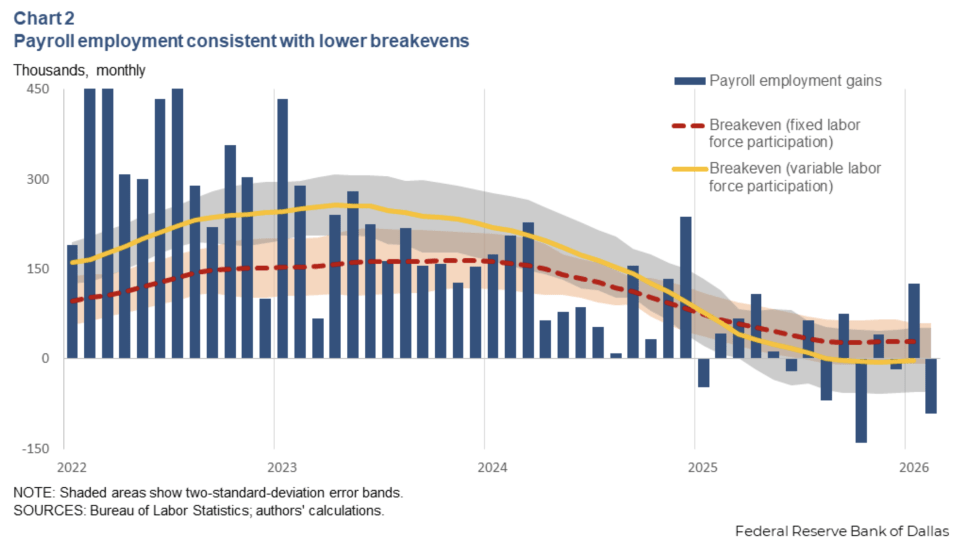
According to a report from Dallas Fed economists on Tuesday, the breakeven rate of employment growth, or the number of net new jobs needed each month to keep the unemployment rate steady, actually went negative during the summer and fall of last year.
That means the economy can shed jobs without lifting the jobless rate, signaling an overall balanced labor market despite a lack of net hiring.
For years, monthly job gains of around 125,000-150,000 were considered necessary to absorb new entrants into the workforce. But with the collapse of net immigration into the U.S., the size of the labor force has stagnated.
Meanwhile, Trump’s trade war last year and war on Iran this year have created economic uncertainty that’s fueling a low-hire, low-fire job market. But a negative breakeven rate could make a no-hire, low-fire market sustainable.
Drawing on data in immigration court records and revised estimates of self-deportations, the Dallas Fed economists calculated that net unauthorized immigration was negative in the second half of 2025, averaging -55,000 per month.
As a result, total net unauthorized immigration for 2025 reached -548,000, about 50% more than the Congressional Budget Office’s latest projection of -365,000.
“Incorporating these updated estimates of net unauthorized immigration into our full model—allowing the labor force participation rate to vary over time—yields substantially lower break-even employment growth than previously estimated,” they wrote. “The breakeven rate peaked at about 250,000 jobs per month in 2023, fell to roughly 10,000 by July 2025, and declined to near zero thereafter, averaging about –3,000 jobs per month from August to December 2025, indicating, if anything, a modest net jobs loss over this period.”
Coinciding with the immigration crackdown, labor force participation has also been in a gradual decline. And Friday’s jobs report showed another drop in participation, helping the unemployment rate dip. The declines were concentrated among men in their 20s and 30s, women between ages 20 and 24, and men over 55.
While the Dallas Fed economists noted it’s difficult to single out factors for the decline, other research has shown that immigrant worker flows boosted employment one for one in recent years.
The report’s findings carry major implications for the Federal Reserve, which is charged with pursuing maximum employment and price stability.
Fed Chairman Jerome Powell has pointed to the unemployment rate as a key gauge of the labor market. Despite last year’s dive in average monthly payroll gains, the jobless rate has barely moved and remains at historically low levels, leading the Fed to proceed cautiously with interest rate cuts.
In fact, the 4.3% unemployment rate in March was little changed from the 4.2% rate in February 2025, Trump’s first full month back in the White House.
“Real-time data point to an important change in the U.S. labor market: The benchmark for evaluating payroll growth has moved significantly,” the Dallas Fed economists said. “As net outflows of unauthorized immigrants reduced employment growth in late 2025, payroll gains that might historically have signaled economic slack are now consistent with a balanced labor market.”
The Iranian military said major oil producer Iraq is exempt from shipping restrictions in the Strait of Hormuz, a potentially significant move for global crude supplies.
“Brotherly Iraq is exempt from any restrictions we have imposed on the Strait of Hormuz,” Iran’s military spokesman said in an Arabic-language video statement published by state-run Islamic Republic News Agency.
The declaration has the potential to unleash as much as 3 million barrels a day of Iraqi oil cargoes. An Iraqi official, however, cautioned that the usefulness of the exemption will depend on whether shipping companies are willing to risk entering the strait to collect cargoes.
It’s not immediately clear if the exemption will apply to all Iraqi oil or just the nation’s tankers, or indeed how it will be enforced.
Even as fighting continues and the US steps up its threats, vessel traffic through the vital strait has ticked up slightly, with a handful of Asian nations negotiating safe passage. A French container ship crossed the strait this week in a first for a western European vessel, and a Japanese-owned LNG tanker also made it out.
Still, the number of transits remains a small fraction of the pre-war rate, when one-fifth of the world’s oil and liquefied natural gas passed the strait.
Early in the war that has raged for five weeks, Iraq and other key Persian Gulf oil producers were forced to slash crude output as the primary export route closed and storage tanks filled to capacity.
Iraqi oil exports plunged by roughly 97% to a daily average of 99,000 barrels in March from the prior month as production shrank and overseas shipments were restricted to a pipeline system that transverses Turkey to the Mediterranean port of Ceyhan.
Iran’s loosening of Hormuz restrictions opens at least an opportunity for Iraq to resume some seaborne shipments, though other hurdles remain, including a lack of clarity on when and by how much the nation’s oil fields can ramp up output.
Regional Brothers
It’s also unclear, given weeks of shipping turmoil, how much tanker capacity will be immediately available to load and haul Iraqi crude from Persian Gulf ports.
Iraq is the second-largest oil producer in OPEC, second only to Saudi Arabia.
The Iranian statement distinguished “brotherly” Iraq from “hostile” states that Tehran has repeatedly said the strait is closed to. Speaking in Arabic rather than Iran’s native Persian, the military spokesman thanked the Iraqi people for their support since the war began.
The two neighbors have close ties — despite a brutal eight-year war in the 1980s — thanks in part to their majority Shia Muslim populations. Iraqi militias form a key node in Iran’s network of regional proxies opposed to the US and Israel, and Baghdad also relies on Tehran for supplies of natural gas.
The next steps in the US military campaign against Iran will commit nearly its entire inventory of stealthy JASSM-ER cruise missiles, drawing them from stockpiles devoted to other regions.
The order to pull the $1.5 million weapon from Pacific stockpiles was issued at the end of March, according to a person with direct knowledge of the matter. Missiles at US facilities elsewhere, including the continental US, will be moved to US Central Command bases or Fairford in the UK, said the person, who was granted anonymity to discuss sensitive details.
After the moves, only about 425 JASSM-ER out of a prewar inventory of 2,300 will remain available for the rest of the globe. That would be roughly enough for 17 B-1B bombers on a single mission. Another 75 or so are “unserviceable” because of damage or technical faults.
The JASSM-ER, or Joint Air-to-Surface Missile-Extended Range, can fly more than 600 miles and was designed to hit targets at a safer distances to avoid an enemy’s air defenses.
Along with the shorter-range JASSM — which has a range of about 250 miles, about two-thirds of US stockpiles have been committed to the Iran war, the person said.
Supplies of missile interceptors and long-range strike weapons have been at issue since the US and Israel launched their air campaign on Feb. 28. Replacing what has been used would take many years’ worth of production at current levels.
The US has been using large numbers of long-range weapons like JASSM-ER for strikes, limiting the risk to service members but reducing stocks of systems meant for more capable adversaries such as China.
The US and Israel have said they destroyed a significant portion of Iran’s air defenses, allowing them to use cheaper weapons to hit targets in the country. But a US F-15E strike fighter was shot down on Friday. Soon afterward, an A-10 attack jet was downed and two combat search-and-rescue helicopters were hit by Iranian fire, the New York Times reported.
US operations through the first four weeks of the war consumed more than 1,000 JASSM-ERs, the person said, speaking on condition of anonymity because of the sensitivity of the matter. US aircraft also fired 47 during the raid to capture Venezuelan President Nicolas Maduro, the person said.
The US has allocated funds to buy more than 6,200 JASSMs since 2009, and production of the baseline JASSM for US supplies ended about 10 years ago.
Lockheed Martin Corp.’s scheduled production rate for 2026 is 396 of the longer-range version, although as many as 860 can be manufactured if the line, which also produces the LRASM anti-ship missile, is fully geared toward JASSMs.
Committing so many JASSM-ERs to the Iran war does not mean they will all be used. So far they have been launched from B-52 and B-1B bombers, as well as strike fighters.
US Central Command and the Department of Defense did not immediately respond to requests for comment.
‘Stone Ages’
It’s not clear what President Donald Trump is planning next for the US campaign. As ground troops, including Marines and paratroopers, move to the region, speculation has swirled about seizing Kharg island, home to Iran’s main oil terminals.
Trump said in a Wednesday night speech that “over the next two to three weeks, we’re going to bring them back to the stone ages where they belong,” without specifying what that meant for Iran’s civilians, military or government.
On Tuesday, Chairman of the Joint Chiefs General Dan Caine said the US had begun to fly B-52s over Iran, implying that airspace was now safer for attacks using cheaper and more plentiful JDAM precision bombs.
But along with the two US planes downed on Friday, Iran has also destroyed more than 12 MQ-9 strike drones during the course of the war.
The fact that the older, slower B-52s were only now flying over Iran “raises questions about the degree to which the US has continued to rely on standoff capabilities,” said Kelly Grieco, a senior fellow at the Stimson Center.
Iran has launched more than 1,600 ballistic missiles around the region, according to Gulf countries’ official reporting, and about 4,000 Shahed-type rudimentary cruise missiles. Defending against ballistic missiles alone would consume at least 3,200 interceptors.
While Lockheed Martin makes about 650 Patriot PAC-3 interceptors per year, the company signed an agreement in January to make 2,000 a year by 2030. The company also makes 96 THAAD interceptors per year, but reached a separate deal to increase that number to 400.
The US has fired hundreds of Tomahawk cruise missiles during the attack on Iran. There were about 4,000 Tomahawks in US stockpiles before the war — including older models and anti-ship variants. RTX Corp. produced about 100 new missiles in 2025, while about 240 older models were upgraded to the latest Block V standard.
President Donald Trump said Saturday that time was running out on his 10-day deadline for Iran to make a peace deal with the US and threatened that the Islamic Republic would face “all hell” in 48 hours.
“Remember when I gave Iran ten days to MAKE A DEAL or OPEN UP THE HORMUZ STRAIT,” Trump said in a social-media post the day before Easter. “Time is running out — 48 hours before all Hell will reign down on them. Glory be to God!”
Trump had extended a five-day deadline to April 6 as preliminary discussions for peace talks got under way in late March. As attacks intensified from all sides, including Iran’s downing of two US military aircraft, Trump’s rhetoric has hardened from his recent attempts to find a way out of the growing conflict.
Trump has warned that if Iran doesn’t agree to his terms — which the government has rejected — and open the Strait of Hormuz to all shipping traffic out of the Persian Gulf, the US would bomb the country’s civilian energy infrastructure, strikes that would likely constitute a war crime under international law.
Missing Pilot
In Iran, the US continued search-and-rescue operations for a crew member from an F-15E fighter jet shot down by Iran on Friday, as Tehran kept up attacks on Gulf Arab states and Israel.
A second US combat plane reportedly crashed in the Persian Gulf the same day. The incidents mark a significant blow for Washington as the war enters its sixth week with energy prices risingand little sign of an end to the conflict.
Trump declined to discuss the search-and-rescue operations in an interview with NBC News on Friday. He said the events wouldn’t affect any peace negotiations with Iran, according to a reporter who spoke to him on a call.
On Saturday, Iran said US-Israeli strikes hit petrochemical plants and forced the evacuation of a large industrial zone. Other attacks targeting the perimeter of Iran’s Bushehr nuclear power plant left one security staff member dead, Iran’s semi-official Tasnim news agency reported. The main sections of the facility, where Russia’s state nuclear company Rosatom has workers, were unaffected, Tasnim said.
Iran continued to fire missiles and drones across much of the Middle East. Dubai authorities reported that debris from an aerial interception fell on the facade of an Oracle Corp. building in Dubai Internet City on Saturday morning. They also reported debris hitting a building in the nearby Dubai Marina area. No fire or injuries were reported.
Iran fired more missiles at Israel. There was damage to a parking lot in Tel Aviv and to buildings in several outlying towns, authorities said, describing the impacts as caused by debris from interceptions. There were no immediate reports of casualties.
The downing of the US jet came despite Trump’s claim in a primetime address on Wednesday that Iran no longer had anti-aircraft equipment. His military commanders, as well as Defense Secretary Pete Hegseth, have previously touted US air superiority over Iranian territory.
It’s the first known combat loss of a US or Israeli plane since the two countries began attacking Iran on Feb. 28. Three US aircraft were downed by friendly fire in Kuwait early in the war, while others have been destroyed or damaged at airbases by Iranian drones and missiles.
The US rescued one of the F-15 crew members, according to an American official who asked not to be identified discussing sensitive information. The status of the second person is unclear and Iranian media said Tehran offered a reward of about $66,000 to citizens who capture the person alive.
The lone pilot of the second plane — an A-10 Warthog — was safely rescued, the New York Times reported.
Iran has continued to hit key energy infrastructure in the past two days.
The UAE’s largest natural gas processing facility, Habshan, suspended operations after debris from a projectile interception sparked a fire. A drone attack set ablaze Kuwait’s Mina Al-Ahmadi oil refinery, which can process almost 350,000 barrels a day of crude.
The United Arab Emirates, of which Dubai is a member, said it detected 79 projectiles fired from Iran on Saturday, including 23 ballistic missiles. That was the highest number of projectiles since March 8, according to data published by UAE authorities, and continued a trend of more numerous attacks over the last three days.
The UAE, like other Gulf states and Israel, has intercepted the vast majority of Iranian attacks.
Israel’s military said it hit air defense sites and missile storage facilities in a wave of airstrikes on Tehran on Friday. Iran said US-Israeli strikes hit a petrochemical zone in Mahshahr, in the southwestern Khuzestan province on Saturday. Authorities ordered the evacuation of all personnel and said any potential pollutants don’t pose a risk to nearby cities, the semi-official Fars news agency reported.
Peace Efforts Stall
Iran has shown little sign of accepting Trump’s demands for peace and has laid out its own conditions — most of them unacceptable to the US and Israel.
The New York Times, citing US intelligence reports, said Iranian personnel have been digging out underground missile bunkers and silos struck by American and Israeli bombs and returning them to operation hours after attacks. That casts doubt on the US and Israel’s ability to destroy Iran’s missile capability — one of their key war goals.
Despite Trump’s weekend threat, the president signaled this week he may be willing to pull US forces out of the conflict in two to three weeks, even if the Strait of Hormuz is still effectively shut.
US allies are stepping up efforts to ensure the waterway — through which one fifth of the world’s oil and liquefied natural gas supplies normally flow — is reopened soon.
Iran’s military said Saturday that Iraq would be exempt from shipping restrictions in the trait, opening the potential of as much as 3 million barrels a day of Iraqi oil cargoes.
More than 40 of their foreign ministers met virtually on Thursday to discuss plans, signaling to Trump their concern about the closure.
On Saturday, Turkish President Recep Tayyip Erdogan said in a social media post that he spoke by phone with Mark Rutte, secretary-general of the North Atlantic Treaty Organization saying the situation was heading for a deadlock and “urged the international community to step up efforts to end the war.”
The group, convened by the UK, was clear that any ceasefire talks with Iran needed to include a solution for Hormuz, people familiar with the discussions said. Still, the meeting, which the US and Iran were not part of, showed the coalition of countries deem it necessary to prepare for having to reopen the strait without Washington.
Bahrain, supported by Jordan and Arab Gulf states, is proposing a United Nations Security Council resolution aimed at helping re-open Hormuz, according to the UAE. It would provide “a clear legal basis for all states to mobilize and support safe passage,” the UAE said in a post on X.
It’s unclear when a vote on the resolution will take place.
Russia, an Iranian ally, pushed back on the initiative, with Foreign Minister Sergei Lavrov saying it would “legitimize aggression against Iran.” The comments signal Moscow may use its veto power, as one of five permanent members of the Security Council.
Ships Trickle Through Strait
Iran appeared to tighten its grip on the strait on Thursday, when its media reported that the government is drafting a protocol with Oman to monitor traffic. That would require shippers to pay tolls to Iran, according to its deputy foreign minister.
The passage is officially in international waters and any attempt by Iran to assert control over traffic will be opposed strongly by Western powers and Gulf Arab states.
A trickle of ships is managing to pass through. A French container ship and a Japanese-owned tanker have crossed the Strait of Hormuz in the past two days, in what appear to be the first such transits since the war in Iran shuttered the crucial waterway.
The energy shock, which has seen gasoline pump prices in the country jump to more than $4 a gallon on average carries political risks for Trump and his Republican Party in the November midterm elections.
US benchmark oil prices, or WTI futures, closed at more than $111 a barrel last week and have almost doubled this year.
More than 5,000 people have been killed in the conflict, almost three-quarters of them in Iran, according to government organizations and the US-based Human Rights Activists News Agency. Just over 1,300 people have been killed in Lebanon, where Israel is fighting a parallel war against Iran-allied Hezbollah.