
Blog

  • Delta CEO says AI’s biggest opportunity in aviation isn’t inside the plane—it’s air traffic control

    Delta CEO says AI’s biggest opportunity in aviation isn’t inside the plane—it’s air traffic control

    [ad_1]

    Delta CEO Ed Bastian doesn’t think AI will drastically change the flying experience, but it may improve it by tackling one of the biggest problems facing airlines.

    Air traffic control, Bastian noted, is ripe for innovation and could be the area where improved technologies like AI make a real difference for travelers—“an amazing deployment,” even if it takes a long time to implement.

    “I think that would do more in terms of helping our customers have quicker travel, more efficient travel than, candidly, most any other deployment of the technology that I can think about we’ve talked in the past,” Bastian told Fortune editor-in-chief Alyson Shontell on the latest episode of the Fortune Titans and Disruptors of Industry podcast.

    Bastian also pointed to AI as a potential tool for better reading the atmosphere, predicting turbulence, and understanding airflow patterns. 

    “If deployed properly, it should make it maybe more efficient, more reliable,” he said.

    Delta is already using some AI in its own operations. In October, the airline rolled out an AI-powered digital travel assistant called Delta Concierge to a select group of users. The virtual assistant, housed in Delta’s app, provides real-time answers to flight-related questions and can help with bag tracking and claims.

    Air traffic control faces challenges

    Bastian’s comments come as the U.S. is dealing with an air traffic control crisis that has festered for years but has become more evident in recent accidents and the ongoing partial government shutdown.

    At the root of the problem are both antiquated technology and staffing issues. Bastian has previously noted that “The screens look like something out of the 1960s and ‘70s.”

    He’s not far off. A 2024 report from the Government Accountability Office found the Federal Aviation Administration has “been slow to modernize some of the most critical and at-risk systems.” At the time, the GAO identified 17 systems critical to the safety and efficiency of the national airspace, whose ages ranged from 2 to 50 years. 

    In terms of staffing, the issue is not much better. The air traffic control workforce has been understaffed for more than a decade, which has led to 10-hour days and six-day work weeks for existing workers, said Nick Daniels, the president of the National Air Traffic Controllers Association, the union representing air traffic controllers, in written testimony submitted to the Senate’s subcommittee on aviation, space, and innovation in November. During the 43-day government shutdown last year, air traffic controllers were required to work full-time without pay, including mandatory overtime in many cases, “despite operating 3,800 fully certified controllers short of the Federal Aviation Administration’s (FAA) staffing target,” according to Daniels.

    In recent history, the role of air traffic controllers, outdated tech, and strained staffing have come to the forefront after two fatal accidents in the past two years. Last month, two Air Canada pilots died when their regional jet collided with a fire truck, and National Transportation Safety Board investigators are looking into whether the air traffic controller played a role. That crash came just over a year after an American Airlines regional jet collided with a U.S. Army Blackhawk helicopter as it approached Reagan National Airport near D.C. The U.S. government in a December court filing, admitted the air traffic controller at the airport “did not comply” with FAA procedures.

    Improvements in progress

    President Donald Trump and Transportation Secretary Sean Duffy last May announced a plan to modernize the country’s air traffic control system to create a state-of-the-art traffic control system “that will be the envy of the world.”

    While the administration’s plan doesn’t mention AI, specifically, it includes replacing outdated infrastructure by adding new radios, radars, and voice switches at 4,600 air traffic control sites nationwide. The administration also plans to build six new traffic control towers, the first since the 1960s, at “hard-to-staff and needed facilities.” The administration’s plan, which Bastian voiced support for in a May press release, will take $31.5 billion to complete, according to Duffy. 

    A spokesperson for the FAA told Fortune in a statement that the agency is beginning to use large language models and machine learning to scan incident reports and other data to identify risk areas at airports that host both airplanes and helicopters, among other uses. Still, the tool is not a replacement for human experts, the spokesperson said.

    “AI is another valuable tool but not a surrogate for human expertise,” the statement read.

    As for the efficiency of air traffic control, Bastian told Fortune that it takes longer to fly from Delta’s base in Atlanta to New York today than it did in the 1950s, when the company launched the route—an issue that more advanced air traffic control technology may help fix.

    “All that technology investment that we put in AI is not going to change that, unless it’s focused on, how do you unlock the sky,” he said. 

    Watch Fortune editor-in-chief Alyson Shontell’s full interview with Delta CEO Ed Bastian, and read the full transcript, here.

    [ad_2]

    Source link

  • Trump seeks biggest defense budget hike in 75 years as Pentagon commits to ‘exquisite’ weapons

    Trump seeks biggest defense budget hike in 75 years as Pentagon commits to ‘exquisite’ weapons

    [ad_1]

    President Donald Trump’s $1.5 trillion Pentagon budget request for the upcoming fiscal year represents the biggest increase in generations and seeks to transform the industry, according to analysts at JPMorgan.

    While Congress is unlikely to fund everything the administration wants, the proposal still signals where Trump’s priorities are as the budget process begins.

    “A global security environment that is less reliant on norms and more reliant on force continues to put upward pressure on defense spending; at the same time, the Trump administration is seeking to remake the U.S. defense industrial base, and there is more capital entering the sector as well,” JPMorgan said in a note on Monday.

    To be sure, getting a defense budget through Congress could drag on, perhaps even past the midterm elections. If Democrats take control, massive defensive spending could be a political nonstarter, especially as Trump looks to cut social programs to partly offset hikes elsewhere.

    For now, the top-line Pentagon budget calls for a 44% increase in fiscal year 2027, which begins this October, including a 77% jump in investments.

    “To contextualize, this would be the biggest single year increase since the budget increased 3.4x to $48B in 1951 on the heels of NSC 68 and the Korean War,” JPMorgan said, referring to a seminal National Security Council paper from 1950 that singled out the Soviet Union as the most serious threat to the U.S.

    Analysts pointed out that the proposed increase would also dwarf the 25% jump in 1981, when President Ronald Reagan began his military buildup as he reignited a Cold War competition against the “evil empire,” his preferred phrase for the Soviet Union.

    Meanwhile, the 74% investment boost would result in weapons procurement more than doubling over a two-year period to spur transformation of the defense industrial base, making it larger, faster, and more resilient, while advanced technologies from the civilian sector are incorporated.

    The price tag for procurement is also elevated by the Pentagon’s continued commitment to acquiring the most cutting-edge weapons. JPMorgan noted that Trump’s budget has even added more “exquisite” weapons, like a new class of battleship and space-based missile interceptors.

    Why not both?

    That’s despite lessons from Ukraine’s success fighting off the Russian invasion by relying on the production of mass quantities of low-cost drones.

    “The apparent lesson at DOD, however, has not been to move the U.S. away from exquisite systems and toward low-cost, distributed capability, but to have both,” JPMorgan said.

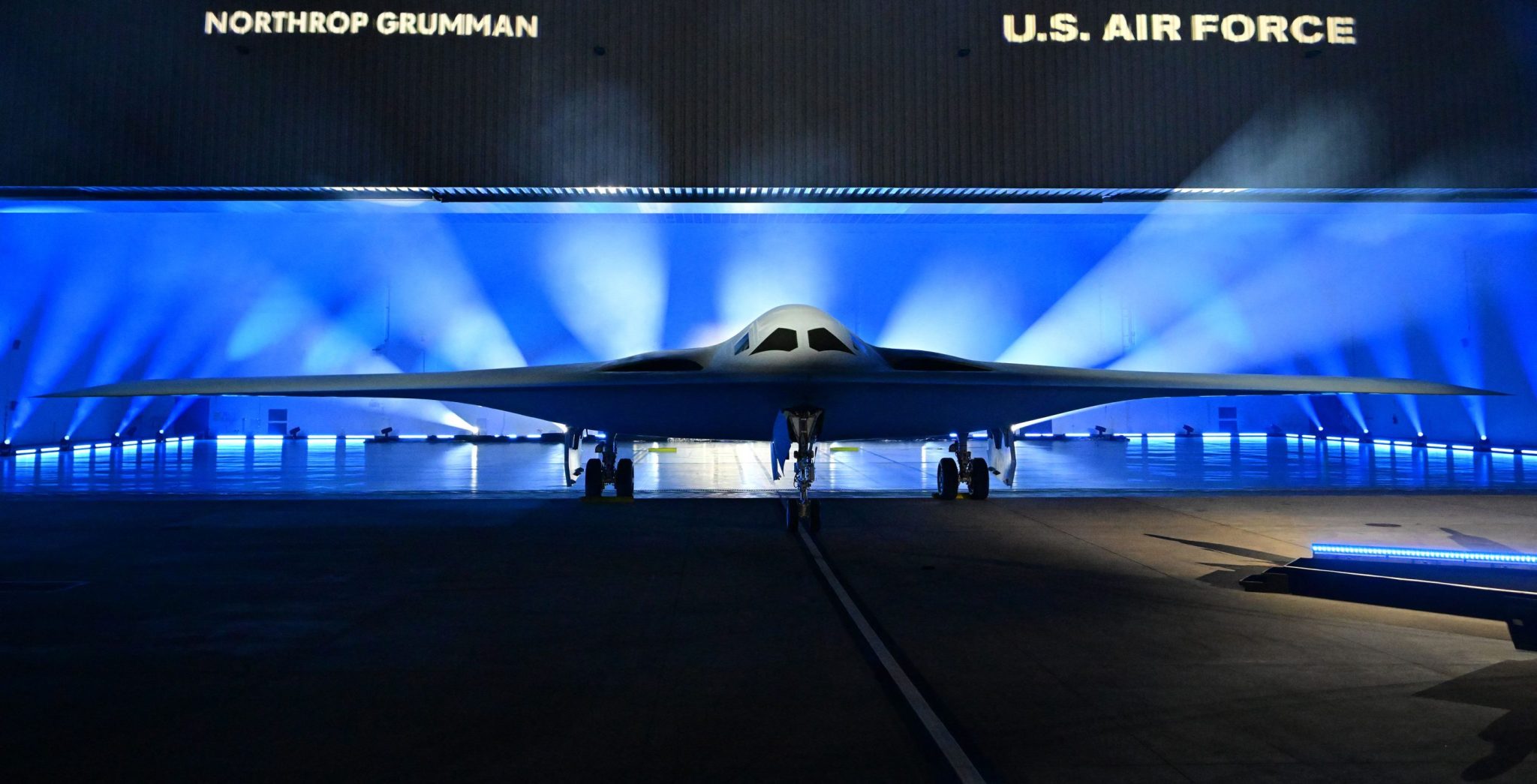
    While the different branches of the armed forces are each pursuing drones or low-cost missiles, they are also staying the course with exquisite, next-generation platforms like a new F-47 fighter that could cost $300 million each and the B-21 stealth bomber that could top $600 million each.

    But the Iran war has also highlighted the effectiveness of low-cost weapons. While the regime’s military has been decimated, its waves of cheap Shahed drones are still able to keep the Strait of Hormuz closed and inflict major damage around the Persian Gulf—including on U.S. military bases.

    Iran’s retaliatory barrage has also forced the U.S. and its allies to draw down expensive stockpiles of interceptors. The tactic highlights the brutal economics of the current war: Missiles that cost millions of dollars each are shooting down drones that cost tens of thousands of dollars.

    The U.S. has long prioritized the most advanced weapons to maintain superiority against any military rivals. But as the pace of technological improvements accelerated in recent decades, costs have ballooned, and the Pentagon has struggled to keep up. 

    The advent of cheap commercial drone technology changed the equation dramatically, as demonstrated by the Ukrainian military’s adoption of new tactics. That four-year-old conflict has transformed warfare. Unmanned weapons are now responsible for most battlefield casualties as small first-person view drones hunt down individual troops or vehicles. Ukraine’s defense industry has also evolved to mass-produce inexpensive drones that can take down Russia-launched Shaheds from Iran.

    “The future of warfare is Ukraine producing 7 million drones per year right now,” former CIA director and retired Gen. David Petraeus said last month. “This past year, they produced 3.5 million. That enabled them basically to use 9,000 to 10,000 drones per day.”

    [ad_2]

    Source link

  • Goldman looked at 40 years of the ‘scarring’ effects of tech and finds Gen Z isn’t the most at risk

    Goldman looked at 40 years of the ‘scarring’ effects of tech and finds Gen Z isn’t the most at risk

    [ad_1]

    Wall Street’s most-watched economics team has a warning for workers displaced by AI: The damage could last for years. But in a surprising twist, the people most expected to bear the brunt of the coming disruption—recent college graduates—may actually be the best equipped to weather it.

    In a research note published Monday, Goldman Sachs economists Pierfrancesco Mei and Jessica Rindels drew on four decades of individual-level data to assess what they call the “scarring” effects of technological displacement on U.S. workers. Their verdict is sobering. Workers whose jobs are eliminated by technology don’t just struggle in the short term—they can spend the better part of a decade fighting to recover.

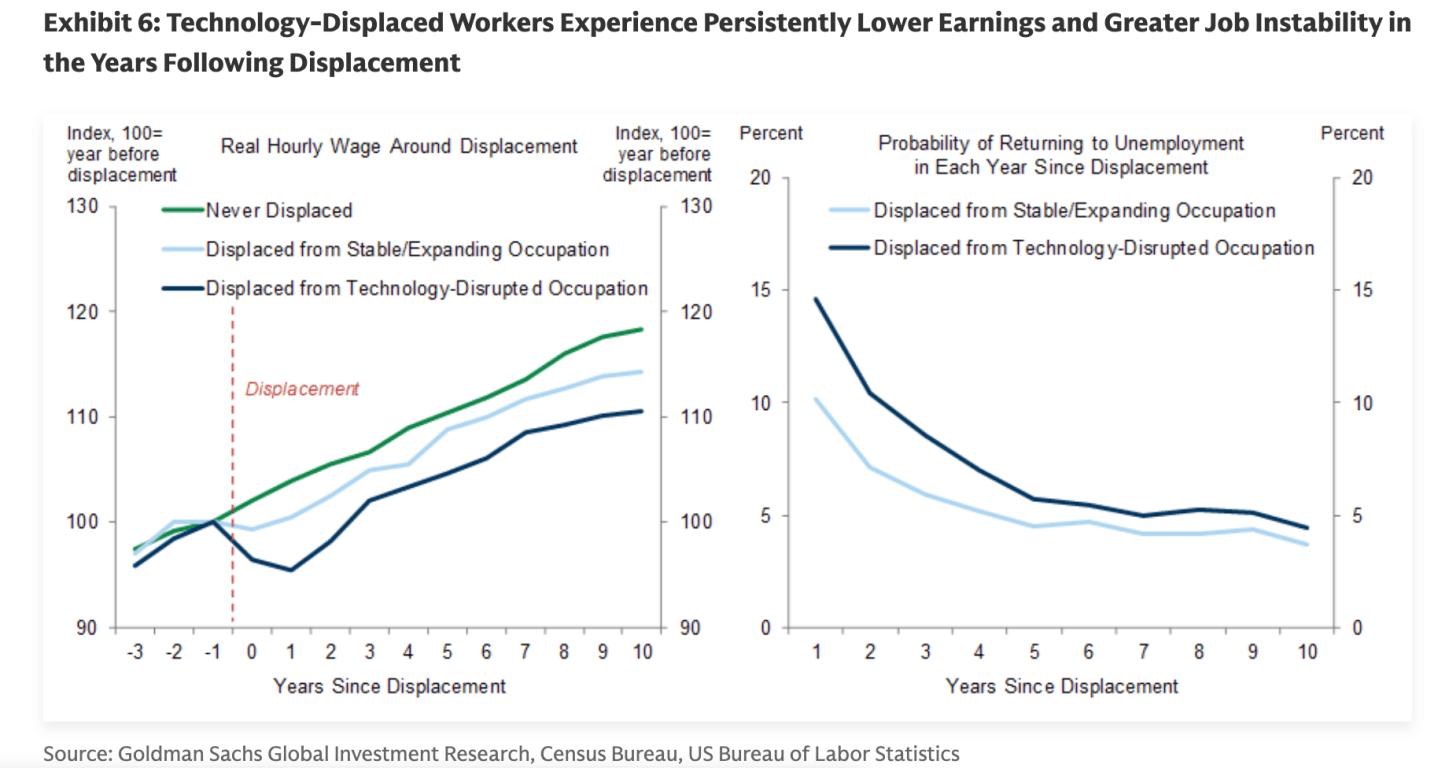
    “Over the 10 years following a job loss, real earnings for technology-displaced workers grow nearly 10 percentage points less than for never-displaced workers,” the report found, “and 5 percentage points less than for other displaced workers.”

    The research team tracked more than 20,000 individuals across two cohorts—one born in the 1950s and ’60s, and another in the 1980s—using the National Longitudinal Surveys sponsored by the Bureau of Labor Statistics. By identifying which occupations faced the steepest technology-driven employment declines in each decade since 1980, they were able to map the full career arcs of workers caught in automation’s path.

    The immediate pain is real

    The short-run picture is rough. Workers displaced from technology-disrupted occupations take approximately one month longer to find a new job and suffer real earnings losses more than 3% larger upon reemployment compared with workers let go from more stable fields. The core culprit, Goldman found, is occupational downgrading: Displaced workers tend to slide into roles that are more routine and require fewer analytical and interpersonal skills, not less, because the same technological forces that eliminated their old jobs also eroded the market value of their existing skills.

    The scarring doesn’t stop at paychecks. Goldman found that workers displaced early in their careers—between ages 25 and 35—accumulate less wealth over time, largely because they delay buying homes. They’re also less likely to be married at any given age compared with never-displaced peers, suggesting the economic shock ripples into their personal lives as well.

    Recessions make everything worse

    Goldman’s most urgent warning may be about timing. Firms disproportionately shed routine jobs during economic downturns, when efficiency pressure peaks. For workers, a recession-era technology displacement widens the already painful gap versus other displaced workers by roughly three additional weeks of unemployment and five percentage points each for the risk of returning to unemployment and exiting the labor force entirely. With AI adoption accelerating at a moment of unusual macroeconomic uncertainty, that compounding risk is hard to ignore.

    The Gen Z twist

    Here’s where the report defies the prevailing narrative. Much of the public anxiety about AI-driven job losses has centered on young workers—particularly new graduates entering a market increasingly shaped by automation. Goldman’s data tells a different story. Younger, college-educated, and urban workers experience cumulative earnings losses roughly half as large as other technology-displaced workers over the decade following a job loss. Their advantage comes from flexibility: They switch occupations more readily and migrate up the skills ladder into roles with higher analytical content that complement, rather than compete with, new technology.

    “Contrary to current concerns that the costs of AI will fall especially hard on new graduates,” the report states, “younger workers have actually been able to adjust more flexibly through occupational mobility and skill upgrading in the past.”

    Retraining also helps cushion the blow. Workers who participated in vocational or technical programs within three years of displacement saw roughly two percentage points more cumulative wage growth over the following decade and a 10-percentage-point lower probability of returning to unemployment.

    Goldman has been estimating for several years that AI could displace 6% to 7% of U.S. workers over the next decade. This 40-year sweep of data suggests the workers who should be most worried aren’t the youngest ones in the room—they’re the older, less mobile workers with deeply occupation-specific skills and no recession-proof timing on their side.

    For this story, Fortune journalists used generative AI as a research tool. An editor verified the accuracy of the information before publishing.

    [ad_2]

    Source link

  • A $400 million ballroom was just the beginning. Now, Trump plans to spend $174 million more

    A $400 million ballroom was just the beginning. Now, Trump plans to spend $174 million more

    [ad_1]

    Last October, the scene of demolition crews using a backhoe to tear down the East Wing of the White House was so dramatic that it became an impromptu tourist attraction. President Donald Trump, who considers himself to be “builder-in-chief,” isn’t done yet. 

    The White House will spend $377 million for renovations and repairs for the presidential residence this year, according to the president’s budget released on Friday. And that’s not even all of it—it’s estimating another $174 million for fiscal year 2027. This would be an 866% increase from the estimated $39 million spent on White House repairs during fiscal year 2025. 

    The money mostly comes from donors, an Office of Management and Budget official told Fortune

    In October, the White House released a list of 37 donors who are funding the East Wing renovations, including Big Tech companies such as Meta Platforms, Apple, Google, and Amazon. There were also a number of individual or family donors, including the Adelson Family Foundation, Secretary of Commerce Howard Lutnick’s family, Blackstone CEO Stephen A. Schwarzman, and cryptocurrency billionaires Cameron and Tyler Winklevoss. 

    The budget does not specify what projects the funding will go toward, but an Office of Management and Budget official told Fortune that the money will cover all repair, renovation, construction, and security costs. These figures represent money already in the government accounts, not a request from Congress for more funding, the official said—an important distinction as many other parts of this budget, such as the record-breaking ask of $1.5 trillion in military spending for next year, are new requests for Congress to approve.

    In a January filing as part of a lawsuit against the National Park Service brought by the National Trust for Historic Preservation, White House Management and Administration Director Joshua Fischer wrote that there are plans to fix water infiltration, update old electrical infrastructure, comply with the Americans with Disabilities Act, and remove asbestos and lead-based paint. “Donated funds received by NPS pursuant to NPS’s gift authority are being transferred to the White House Repair and Restoration Account pursuant to the Economy Act,” Fischer wrote in the filing, “to fund this project and supplement the Executive Mansion’s annual allowance appropriated,” which is $2 million for fiscal year 2026, and $6 million in 2027.

    Last year, Trump replaced the Rose Garden lawn—a space that has been used for decades for bill signings, press conferences, and formal dinners—with a stone patio for events. He dubbed the renovated space the “Rose Garden Club,” a space “for senators, for congresspeople and for people in Washington, and frankly, people that can bring peace and success to our country,” Trump said at an event in September. 

    He had also planned to host tech executives in the space in September, many of whom run companies that later donated to the ballroom project, but the event was moved inside due to the weather.  

    Some $350 million of the estimated $377 million is considered mandatory spending, a designation used for programs Congress funds by statute, such as Medicare and Social Security, rather than yearly appropriation. The private, tax-deductible donations were placed in the National Park Service gift account, which is a mandatory account, according to the OMB official, and not subject to yearly congressional appropriations. 

    The ballroom is the most prominent project that has been announced. Trump repeatedly said that taxpayers will not foot the $400 million bill for the 90,000-square-foot ballroom renovation. When the plan for the ballroom was announced in July, the president said it would cost half the price. 

    “I am honored to be the first President to finally get this much-needed project, which is on time and under budget, underway,” Trump said on social media on April 2. “When completed, it will be the Greatest and Most Beautiful Ballroom of its kind anywhere in the World, and a fabulous complement to our Beautiful and Storied White House!”

    [ad_2]

    Source link

  • Sam Altman’s big pitch to fix the big AI mess sounds like Jamie Dimon’s: a 4-day workweek and a big new tax on rich people like him

    Sam Altman’s big pitch to fix the big AI mess sounds like Jamie Dimon’s: a 4-day workweek and a big new tax on rich people like him

    [ad_1]

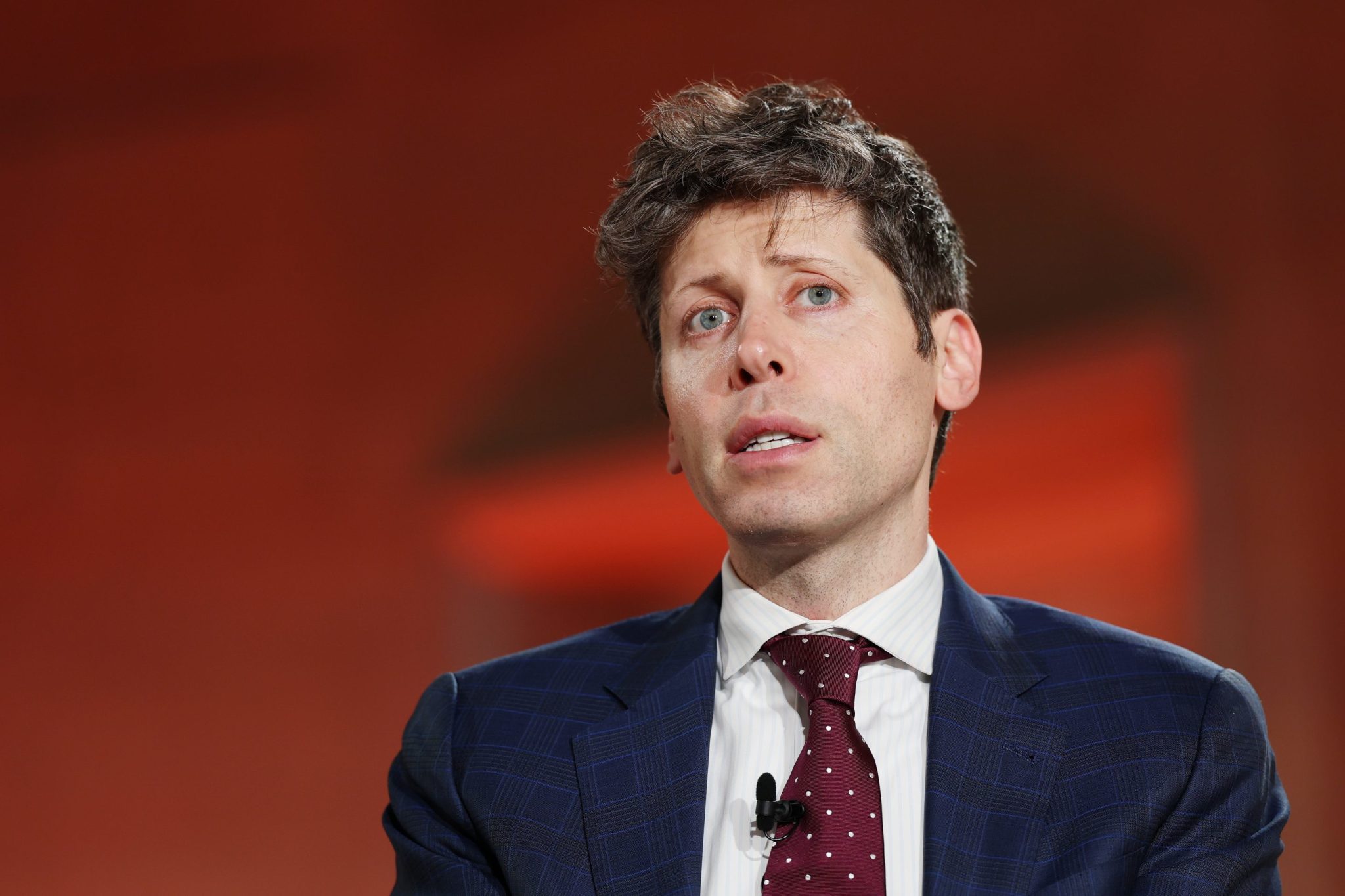
    Sam Altman wants Washington to tax AI’s winners — and he’s put it in writing.

    On Monday, OpenAI released a 13-page paper entitled “Industrial Policy for the Intelligence Age: Ideas to Keep People First.” It offers a sweeping policy blueprint that proposes tax hikes on corporate income, among other revenue-boosting levers that shift the tax burden from labor to capital. 

    “Policymakers could rebalance the tax base by increasing reliance on capital-based revenues—such as higher taxes on capital gains at the top, corporate income, or targeted measures on sustained AI-driven returns—and by exploring new approaches such as taxes related to automated labor,” the report reads.

    Even in the face of relentless warnings about AI’s presumed labor market disruption, the Trump administration has doubled down on an anti-regulatory stance on the technology’s development. In December, President Donald Trump signed an executive order reducing “burdensome” state rule and preventing “cumbersome regulation.”

    Fortune reached out to OpenAI for comment, inquiring about the AI policy proposal.

    The four-day work week, retraining, and a public wealth fund

    The proposal goes beyond mere tax policy. It offers a series of policies meant to focus the gains of AI on workers, including incentivizing firms to “retain, retrain, and invest in workers,” a four-day work week without a pay cut, and the creation of a “public wealth fund” that provides all U.S. citizens a stake in AI economic growth.

    Many of those policies sound like proposals coming from top leaders in business. JPMorgan Chase CEO Jamie Dimon also thinks AI will shave the work week down to three and a half days, and improve life, even curing some cancers. But he’s just as wary as Altman and other business leaders about the technology’s impact on the labor market. He has said he thinks the government should have the power to intervene in blocking AI-induced layoffs. And last month, the billionaire proposed a government-business incentive program meant to cushion workers impacted by AI-related job displacement. 

    “I don’t know the answer yet, but I would suggest it’s the following: It can’t be just government. It’s got to be business,” Dimon said in an interview at the Hill and Valley Forum. “But the government could create a system of incentives that business does the right thing to retrain people, early retirement, moving people.”

    In an interview with Axios, Altman recounted a conversation with a “senior Republican” who admitted that while they typically support free markets, they recognize that AI is seriously disrupting the economy. 

    “Capitalism has depended on some balance between labor and capital,” he said, citing the Republican. “Way too much leverage is going to be with capital and not with labor in the traditional sense.”

    The CEO has flip-flopped on regulation in the past. In 2023, Altman testified before Congress, urging the government to implement regulations for AI and emphasizing its potential risks. But less than a year ago, he appeared again in front of a Congress composed of those largely favorable to him, and called for regulation, but regulation that “does not slow us down.” His comments Monday mark a contrast to those delivered before Congress even a year ago.

    Akin to the New Deal and Progressive Era

    Many of these ideas, though, remain mere ideas. The president and the Republican-controlled Congress don’t appear to have an appetite for AI regulation. While Congress passed, and Trump signed the TAKE IT DOWN Act, a law regulating deepfakes, other efforts discourage strong regulation. The president last month released an AI policy framework for Congress that echoes his executive order, meant to build on efforts to protect children, but to discourage strong state laws that “hinder our national competitiveness.” However, the framework also includes a proposal meant to ensure workers benefit from AI growth through skill development and retraining.

    But it’s not the first time, OpenAI argues, that technology has threatened to leave workers behind, requiring strong regulation. The paper compares the current moment to the New Deal and Progressive Era.

    “Society has navigated major technological transitions before, but not without real disruption and dislocation along the way,” the paper reads. “While those transitions ultimately created more prosperity, they required proactive political choices to ensure that growth translated into broader opportunity and greater security.”

    [ad_2]

    Source link

  • How people are reacting to OpenAI’s 13-page policy paper on AI superintelligence

    How people are reacting to OpenAI’s 13-page policy paper on AI superintelligence

    [ad_1]

    OpenAI says the world needs to rethink everything from the tax system to the length of the workday in order to prepare for the wrenching changes of superintelligence technology—the point at which AI systems are capable of outperforming the smartest humans.

    On Monday, in a 13-page paper titled “Industrial Policy for the Intelligence Age,” OpenAI said it wanted to “kick-start” the conversation with a “slate of people-first policy ideas.” How much faith to put in OpenAI’s words and motives, however, seems to be one of the key questions among many of the people reading the paper. The paper was released on the same day that The New Yorker published the results of a lengthy one-and-a-half-year investigation into OpenAI that raised questions about CEO Sam Altman’s trustworthiness on various issues, including AI safety.

    Written by the OpenAI global affairs team, the paper outlines many of the expected economic impacts of superintelligence and floats various approaches for addressing them. “We offer them not as a comprehensive or final set of recommendations, but as a starting point for discussion that we invite others to build on, refine, challenge, or choose among through the democratic process,” said the introductory blog post. 

    The self-described “slate of ideas” in the document—spanning everything from public wealth funds to shorter workweeks—may not do much to reassure a public increasingly nervous about and disenchanted with the pace and consequences of AI-driven change. And OpenAI, of course, is one of the least neutral parties in this ongoing discussion, which is the core tension of the document, said Lucia Velasco, a senior economist and AI policy leader at D.C.-based Inter-American Development Bank and former head of AI policy at the United Nations Office for Digital and Emerging Technologies. 

    “OpenAI is the most interested party in how this conversation turns out, and the proposals it advances shape an environment in which OpenAI operates with significant freedom under constraints it has largely helped define,” she said, adding that this wasn’t a reason to dismiss the document, but “it is a reason to ensure that the conversation it is trying to start does not end with the same company that started it.”

    Still, she emphasized that OpenAI is correct in saying that governments are behind in advancing policy solutions. “Most are still treating AI as a technology problem when it’s actually a structural economic shift that needs proper industrial policy,” she said. “That‘s a useful contribution, and the document deserves to be taken seriously as an agenda-setting exercise, even if it’s a starting point.”

    Soribel Feliz, an independent AI policy advisor who previously served as a senior AI and tech policy advisor for the U.S. Senate, agreed that OpenAI deserves credit for “putting this on paper.” The acknowledgment that both U.S. institutions and safety nets are falling behind AI development and deployment is correct, she said, “and the conversation needs to happen at this level at this moment.” 

    However, she emphasized that most of what is being proposed is not new: “Some of these pillars—‘share prosperity broadly, mitigate risks, democratize access’—have been the framework for every major AI governance conversation since ChatGPT came out in November 2022.

    “I worked in the U.S. Senate in 2023–24, and we had nine AI policy fora sessions where all of this was said. I have it in my handwritten notes! All of this was already said, all of it,” she wrote to Fortune in a direct message. “The language around public-private partnerships, AI literacy, and worker voice reads like it came out of a Unesco or OECD AI policy framework report. The ideas are not wrong. The problem is the gap between naming the solutions and building real mechanisms to achieve them.” 

    Clearly, the target audience is not its hundreds of millions of weekly ChatGPT users. Instead, it is the Beltway policymakers who have been pushing for AI regulation (or kicking the can down the road) in various forms ever since ChatGPT was released in November 2022. In that sense, some said it represents an improvement over earlier efforts. 

    “I found this document to genuinely be a real improvement from previous documents that were even more floaty and high-level,” said Nathan Calvin, vice president of state affairs and general counsel of Encode AI. “I think some of the concrete suggestions around things like auditing or incident reporting and government restrictions on certain uses of AI are good ideas.” 

    But he also pointed to lobbying efforts led by OpenAI executives with the Leading the Future PAC, which lobbies for AI-industry-friendly policies. Global affairs head Chris Lehane is considered a force behind these efforts, while president Greg Brockman has been the biggest donor. 

    “I hope this document signals a move toward more constructive engagement, instead of attacking politicians pushing the very policies OpenAI is now endorsing,” said Calvin, pointing specifically to Leading the Future’s lobbying against New York congressional candidate Alex Bores, author and primary sponsor of the RAISE Act, the New York AI safety and transparency law recently signed by Gov. Kathy Hochul.

    Calvin has also accused OpenAI of using intimidation tactics to undermine California’s SB 53, the California Transparency in Frontier Artificial Intelligence Act, while it was still being debated. He alleged as well that OpenAI used its ongoing legal battle with Elon Musk as a pretext to target and intimidate critics, including Encode, which the company implied was secretly funded by Musk. 

    Still, while OpenAI CEO Sam Altman compared Monday’s slate of policy ideas to the New Deal in an interview with Axios, some say it reads less like FDR-era legislation and more like a Silicon Valley thought experiment that won’t magically turn into action.

    For example, Anton Leicht, a visiting scholar with the Carnegie Endowment’s technology and international affairs team, wrote on X that in reality, the ideas are fundamental societal changes and heavy political lifts. “They’re not just going to emerge as an organic alternative,” he wrote. “On that read, this is comms work to provide cover for regulatory nihilism.”

    A better version of this, he said, would be to redirect the AI industry’s political funding and lobbying skills to make progress on this kind of policy agenda. However, he said that the “vague nature and timing” of the document “doesn’t make me too optimistic.”

    [ad_2]

    Source link

  • Associated Press starts offering buyouts to newspaper journalists amid wider AI transformation

    Associated Press starts offering buyouts to newspaper journalists amid wider AI transformation

    [ad_1]

    The Associated Press, one of the world’s oldest and most influential news organizations, said Monday it is offering buyouts to an unspecified number of its U.S.-based journalists as part of an acceleration away from the focus on newspapers and their print journalism that sustained the company since the mid-1800s.

    The News Media Guild, the union that represents AP journalists, said more than 120 staff members received buyout offers on Monday.

    The news organization is becoming more focused on visual journalism and developing new revenue sources, particularly through companies investing in artificial intelligence, to cope with the economic collapse of many legacy news outlets. Once the lion’s share of AP’s revenue, big newspaper companies now account for 10% of its income.

    “We’re not a newspaper company and we haven’t been for quite some time,” Julie Pace, executive editor and senior vice president of the AP, said in an interview.

    Despite changes – the company has doubled the number of video journalists it employs in the United States since 2022 – remnants of a staffing structure built largely to provide stories to newspapers and broadcasters in individual states have remained.

    That has its roots well back in American history; the AP was started in the mid-19th century by New York newspapers looking to share the costs of reporting outside their immediate territory.

    Exact numbers of staff reduction unclear

    The number of AP journalists who will lose jobs is murky, in part intentionally. The AP does not say how many journalists it employs, though it has a large international presence as well as its U.S. staff. Pace said the AP’s goal is to reduce its global staff by less than 5%.

    Since buyouts are being offered now to only U.S. journalists, it stands to reason that the cut among that workforce will be more than 5%. Whether there are layoffs depends on how many people take the offer, Pace said.

    “The AP employs hundreds of talented journalists who are willing and able to adjust to the changing media landscape,” the union said in a statement. “However, the company refuses to offer them appropriate training and tools. Instead, AP continues to get rid of experienced staff and flirt with artificial intelligence — ignoring the opportunity to differentiate AP news stories as ones that are and always will be created by human journalists.”

    The union said AP ignored a request last week to bargain over artificial intelligence. The news outlet had no immediate comment on that claim, or the union’s estimate of how many people were offered buyouts. It’s not clear whether the buyout offers were concluded by Monday afternoon.

    Over the past four years, the AP’s revenue from newspapers has declined by 25%. Gannett and McClatchy, two of the largest traditional newspaper publishers, dropped AP in 2024.

    In recent days, the company learned that Lee Enterprises — publishers of newspapers like The Buffalo News, the St. Louis Post-Dispatch and the Richmond Times-Dispatch — is seeking an early exit from a contract due to expire at the end of 2026.

    Pace said the buyout plan was in the works before learning about Lee Enterprises. “We made a decision earlier this year that we needed to be bolder in this transformation,” she said.

    An even higher focus on the day’s biggest stories

    Besides the transition to more video capabilities, the AP is deploying rapid-response teams where staff members, no matter their geographic base, contribute to the day’s big stories, she said. The AP is putting more journalists on beats to break news on topics of known customer interest. But it is committed to maintaining a presence in all 50 states.

    “The AP is not in trouble,” Pace said. “We’re making these changes from a position of strength but we’re doing so now to recognize our changing customer base.”

    Those customers now are dominated by broadcast, digital and technology companies, an illustration of where people are getting news. The AP has seen 200% growth in revenue from technology companies over the last four years, said Kristin Heitmann, senior vice president and chief revenue officer.

    The AP was among the first news outlets to make a deal with an AI company, agreeing in 2023 to lease part of its text archive to OpenAI as it built out its capabilities. The AP launched on Snowflake Marketplace last year to license data directly to enterprises building their own system. It has launched AP Intelligence, a division designed to sell data to financial and advertising sectors, for example.

    Google contracted with AP last year to deliver news through the Gemini chatbot, the tech giant’s first deal with a news publisher.

    “If you can think of a large technology company,” Heitmann said, “they are a customer of ours.”

    Predictions markets now part of the picture for AP

    Last month, the AP agreed to sell U.S. elections data to Kalshi, the world’s largest predictions market.

    AP’s long tradition in counting and analyzing elections data is another growth area; the company saw a 30% increase in customers between the 2020 and 2024 cycles. It got an additional boost last year when ABC, CBS, NBC and CNN signed on to the service.

    The company, traditionally a wholesaler of news to other companies, has also seen growing interest in its direct-to-consumer product, apnews.com, which provides revenue through advertising and donations.

    The new business frontiers do not indicate a weakening in the AP’s standards of providing fast, accurate, non-biased news, leaders said. “It anything, it makes it more important that we retain these values as we make the transition,” Pace said.

    The AP is trying new forms of fact-checking, including use of video, and more often putting its journalists in public to explain how they got particular stories, she said.

    “I think that authenticity, and the fact that you can associate a real person who is often quite experienced and quite deep on their beats … it builds more credibility,” she said. “We’re really trying to embrace that because I do think it’s vital when there is so much misinformation out there.”

    [ad_2]

    Source link

  • ‘No one’s raising their hand’: Japan’s labor crisis shows robots are taking jobs that you don’t want

    ‘No one’s raising their hand’: Japan’s labor crisis shows robots are taking jobs that you don’t want

    [ad_1]

    Japan is running out of workers. Its population declined for a 14th straight year in 2024, its working-age population is projected to shrink by nearly 15 million over the next two decades, and a 2024 Reuters/Nikkei survey found that labor shortages are the primary force pushing Japanese firms toward automation and AI adoption.

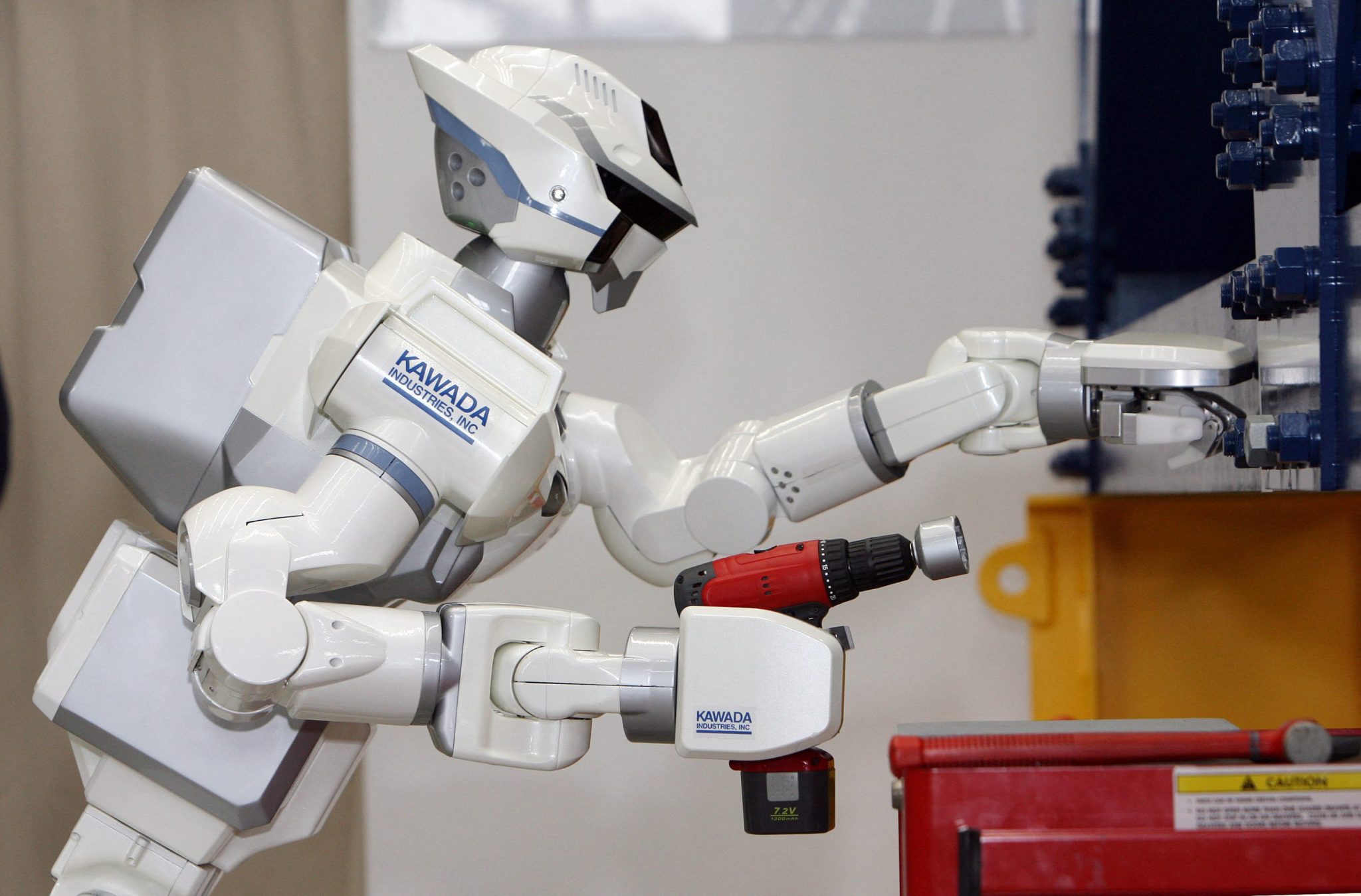
    Last month, the Ministry of Economy, Trade and Industry said it was looking to build a domestic physical AI sector, with hopes of holding 30% of the global market by 2040. The idea is to employ robots in logistics warehouses, on factory floors, and inside data centers—where they’re not taking people’s jobs, but filling the ones no one wants. 

    Ally Warson, a partner at UP.Partners, a venture firm focused on transportation tech and the physical world, has been telling investors this for years. Japan’s labor shortage is one prime example of where it’s becoming evident.

    That’s all the more accentuated in fields where there’s a large demand for labor and few people to fill those roles. For example, Japan is looking to employ robots to take care of its aging population in home health scenarios and in other domestic sectors. 

    In fact, they’ll become so ubiquitous that a recent Bank of America report predicted people will soon own more humanoid robots than cars by 2060.

    “The reality is, no one wants to do these jobs,” Warson told Fortune. For example, “there are something like 600,000 unfilled jobs in the industrial space. No one’s raising their hand and signing up for it.”

    Robots are building walls

    The UBS Global Entrepreneur Report 2026, which surveyed 215 business leaders with a combined $34.3 billion in revenue, found that 47% of entrepreneurs with industrial businesses see automation and robotics as the biggest commercial opportunity.

    The UBS researchers spoke with the head of a Luxembourg construction and property firm who drew a distinction between AI and the physical potential of robotics. “In the construction industry, AI has limited uses. This is a physical business, and AI can’t build a wall. There’ll be robots at some point in time, but not yet,” the firm’s leader told the UBS researchers. 

    Warson agrees. Although robots are not there yet, she said, there are plenty of jobs where the risk to a person’s life makes it a prime target for robotics automation. In tunnel construction, “you can just have a robot keep boring” instead of possibly sending a manned crew to hazardous conditions. Or something as visible as window-washing: “even hanging someone off the side of a building hundreds of feet in the air to window wash. Why is this still a thing?”

    For Warson, the most compelling case for physical AI has never been efficiency or cost-cutting. Rather, it’s keeping people alive.

    “I think the economics works the most for jobs where human lives are at risk,” she said. “If you’re talking about replacing a person who’s walking through a construction site at midnight where there are nails sticking out of the ground, or you’re asking someone to go to an offshore oil and gas site because there’s a leak, that’s a million-dollar-plus life insurance claim on top of any sort of lawsuits.”

    Preparing for a robotic future ahead

    UP.Partners has put real money behind these ideas. The firm backed Noble Machines, a construction robotics company engineered specifically for the chaos of real job sites. The robots are capable of navigating stairs, stabilizing under pressure, and operating in unstructured environments that earlier industrial robots couldn’t handle. It also invested in WakeCap, a hardware-software platform that monitors construction workers, and has seen a 91% drop in safety observations. 

    “WakeCap is helping humans be safer on construction sites,” Warson said, describing the company’s sensors that are built into hardhats and track real-time activity. “That goes back to insurance. You could even take the lens of: AI is helping humans be safer, in a lot of different provocative ways.”

    Combining AI with robotics is the fastest sure-fire way to achieve real, tangible results. This is reiterated by Japan’s $6.3 billion investment in robotics under Prime Minister Sanae Takaichi, according to a report by Franklin Templeton.

    According to the economy ministry, the country already controls about 70% of the global industrial robotics market, and the country looks to accomplish even more by its 2040 deadline by adding AI to the mix. 

    But none of this means the robot apocalypse is imminent. Warson said the underlying infrastructure for physical AI has finally caught up with real-life use cases. Internet-connected sensors are now ubiquitous on job sites. Compute is powerful enough to run sophisticated models at the edge. And AI models are giving machines the ability to generalize across physical environments in ways that would have been unthinkable five years ago. “AI has unlocked the potential for robotics as an asset class,” Warson said. 

    [ad_2]

    Source link

  • The Artemis II astronauts have officially gone further from earth than any humans have gone before

    The Artemis II astronauts have officially gone further from earth than any humans have gone before

    [ad_1]

    With the moon now filling their windows, the Artemis II astronauts set a record Monday as the farthest humans from Earth during a lunar flyby promising magnificent views of the far side never before witnessed.

    The six-hour flyby is the highlight of NASA’s first return to the moon since the Apollo era with three Americans and one Canadian — a step toward landing boot prints near the moon’s south pole in just two years.

    First came a prize — and bragging rights — for Artemis II.

    Less than an hour before kicking off the fly-around and intense lunar observations, the four astronauts surpassed the distance record of 248,655 miles (400,171 kilometers) set by Apollo 13 in April 1970.

    They kept going, hurtling ever farther from Earth. Before it was all over, Mission Control expected Artemis II to beat the old record by more than 4,100 miles (6,600 kilometers).

    “It is blowing my mind what you can see with the naked eye from the moon right now. It is just unbelievable,” Canadian astronaut Jeremy Hansen radioed ahead of the flyby. He challenged “this generation and the next to make sure this record is not long-lived.”

    Moments after breaking Apollo 13’s record, the astronauts asked permission to name two fresh lunar craters already observed. They proposed Integrity, their capsule’s name, and Carroll in honor of commander Reid Wiseman’s late wife who died of cancer in 2020. Wiseman wept as Hansen put in the request to Mission Control, and all four astronauts embraced in tears.

    “Such a majestic view out here,” Wiseman radioed.

    The astronauts started the momentous day with the voice of Apollo 13 commander Jim Lovell, who recorded a wake-up message just two months before his death last August. “Welcome to my old neighborhood,” said Lovell, who also flew on Apollo 8, humanity’s first lunar visit. “It’s a historic day and I know how busy you’ll be, but don’t forget to enjoy the view.”

    They took up with them the Apollo 8 silk patch that accompanied Lovell to the moon, and showed it off as the crucial flyby approached. “It’s just a real honor to have that on board with us,” said Wiseman. “Let’s go have a great day.”

    Artemis II is using the same maneuver that Apollo 13 did after its “Houston, we’ve had a problem” oxygen tank explosion wiped out any hope of a moon landing.

    Known as a free-return lunar trajectory, this no-stopping-to-land route takes advantage of Earth and the moon’s gravity, reducing the need for fuel. It’s a celestial figure-eight that will put the astronauts on course for home, once they emerge from behind the moon Monday evening.

    Wiseman, Hansen, pilot Victor Glover and Christina Koch were on track to pass as close as 4,070 miles (6,550 kilometers) to the moon, as their Orion capsule whips past it, hangs a U-turn and then heads back toward Earth. It will take them four days to get back, with a splashdown in the Pacific concluding their test flight on Friday.

    Their expected speed at closest approach to the moon: 3,139 mph (5,052 kph).

    Wiseman and his crew spent years studying lunar geography to prepare for the big event, adding solar eclipses to their repertoire during the past few weeks. By launching last Wednesday, they ensured themselves of a total solar eclipse from their vantage point behind the moon, courtesy of the cosmos.

    Topping their science target list: Orientale Basin, a sprawling impact basin with three concentric rings, the outermost of which stretches nearly 600 miles (950 kilometers) across.

    Other sightseeing goals: the Apollo 12 and 14 landing sites from 1969 and 1971, respectively, as well as fringes of the south polar region, the preferred locale for future touchdowns. Farther afield, Mercury, Venus, Mars and Saturn — not to mention Earth — will be visible.

    Their moon mentor, NASA geologist Kelsey Young, expects thousands of pictures.

    “People all over the world connect with the moon. This is something that every single person on this planet can understand and connect with,” she said on the eve of the flyby, wearing eclipse earrings.

    Artemis II is NASA’s first astronaut moonshot since Apollo 17 in 1972. It sets the stage for next year’s Artemis III, which will see another Orion crew practice docking with lunar landers in orbit around Earth. The culminating moon landing by two astronauts near the moon’s south pole will follow on Artemis IV in 2028.

    While Artemis II may be taking Apollo 13’s path, it’s most reminiscent of Apollo 8 and humanity’s first lunar visitors who orbited the moon on Christmas Eve 1968 and read from the Book of Genesis.

    Glover said flying to the moon during Christianity’s Holy Week brought home for him “the beauty of creation.” Earth is an oasis amid “a whole bunch of nothing, this thing we call the universe” where humanity exists as one, he observed over the weekend.

    “This is an opportunity for us to remember where we are, who we are, and that we are the same thing and that we’ve got to get through this together,” Glover said, clasping hands with his crewmates.

    ___

    The Associated Press Health and Science Department receives support from the Howard Hughes Medical Institute’s Department of Science Education and the Robert Wood Johnson Foundation. The AP is solely responsible for all content.

    [ad_2]

    Source link

  • Polymarket apologizes after allowing wagers on status of pilot in downed U.S. F-15 in Iran

    Polymarket apologizes after allowing wagers on status of pilot in downed U.S. F-15 in Iran

    [ad_1]

    Predictions market platform Polymarket removed a market on its site that allowed users to bet on the condition of U.S. pilots following attacks on U.S. fighter jets.

    Iran forces shot down two U.S. military planes on Friday in two separate attacks, including a U.S. F-15E Strike Eagle. One American service member was rescued on Friday, while another remained missing for part of the weekend. It was the first time U.S. aircraft were downed during the ongoing war in the Gulf.

    The market on the platform, which has since been deleted, allowed users to wager on what day the pilots would be rescued. President Donald Trump confirmed on social media on Sunday that the service member who went missing had been saved.

    However, the existence of the market drew outrage from some lawmakers, such as Democratic Rep. Seth Moulton, a Marine Corps combat veteran representing Massachusetts, who called betting on outcomes of the Iran war a “dystopian death market.”

    There is an ongoing search and rescue operation for a missing American service member whose plane was shot down over Iran. Their safety is unknown,” Moulton wrote in an X post. “They could be your neighbor, a friend, a family member. And people are betting on whether or not they’ll be saved. This is DISGUSTING.”

    Polymarket responded, saying, “We took this market down immediately as it does not meet our integrity standards. It should not have been posted, and we are investigating how this slipped through our internal safeguards.”

    Polymarket users can make wagers on any topics, from the price of oil, to how many times Elon Musk will post on X over the course of a week, to when Grand Theft Auto VI will be released. The platform’s guidelines prohibit trades made on illegal tips, nonpublic information, or on anything that would impact the income of a real-life event. Polymarket says on the site it reserves the right to review markets and take disciplinary action on traders, including banning wallet addresses.

    Moulton appeared to take issue with Polymarket’s apology, noting in another social media post that there were more than 200 markets on the platform related to the war’s outcomes.

    “Your integrity standards are severely lacking, @Polymarket,” he said in another post. “Users are still able to place bets on the lives of our troops.”

    Polymarket did not respond to Fortune’s request for comment.

    Ethical concerns around prediction markets

    Prediction markets have drawn broader scrutiny over the course of the conflict in Iran. Kalshi said it would offer refunds to traders who placed bets on when Ayatollah Ali Khamenei would be ousted from leadership. He was killed on Feb. 28 in the U.S.-Israeli strikes on Iran. Kalshi CEO Tarek Mansour said the site does not allow markets directly tied to deaths.

    Ethical concerns surrounding these markets extend beyond bets on an individual’s or a group’s well-being. CNN reported last month that one Polymarket trader made nearly $1 million since 2024 from dozens of bets correctly predicting the U.S. and Israel would take military action against Iran. The user won 93% of their five-figure wagers, even on military operations that were not public information, raising concerns of insider trading.

    Connecticut, Arizona, and Illinois have sued platforms like Kalshi and Polymarket to regulate them, accusing the sites of engaging in illegal online gambling that violates state law.

    How Polymarket is addressing controversial bets

    Founded in 2020, Polymarket is among a cadre of prediction markets, serving as a popular tool to crowdsource real-time data and public opinion. Global prediction market trading volumes quadrupled from 2024 to 2025, according to data from Next.io, surging to nearly $64 billion. 

    The nature of some wagers placed on these markets has raised concerns about how users handle the sensitivity of geopolitics and climate disasters. In January 2025 amid the raging wildfires in California, Polymarket users placed dozens of bets on how many acres the blaze would spread. Bates College environmental studies professor Tyler Austin Harper called the “gamblificatation” of all events, including those in which people’s lives are at stake, “Capital-E Evil.”

    Unlike counterparts like Kalshi, Polymarket is not based in the U.S., where regulations are understood to prohibit bets on financial contracts related to war. In the week ending March 1, Polymarket traders placed more than $425 millions on geopolitical bets, according to Dune Analytics, nearly triple the amount from the week before. The U.S. and Israel’s first attack on Iran was on Feb. 28.

    Polymarket CEO Shayne Coplan recently suggested the platform has a complicated relationship with war bets, which he said can provide up-to-date, helpful information to individuals impacted by geopolitical conflicts. He said  at the MIT Sloan Sports Analytics Conference 2026 last month the platform’s association with war contracts brought “more money, more problems.”

    “There’s still a lot of resistance to innovation that kind of also seems jarring to begin with,” Coplan said. “That’s what makes it innovative and disruptive.”

    “When I get hit up by people in the Middle East who are saying, ‘Hey, we’re looking at Polymarket to decide whether we sleep near the bomb shelter; we look at it every day’ and I’m like, ‘Oh, it’s really that popular over there?’” he said. “That’s very powerful. That’s an undeniable value proposition that did not exist before.”

    [ad_2]

    Source link